

Automation’s role in orbital welding
Today’s orbital welding systems employ a variety of
automated features to help welders complete accurate,
high-quality welds, and increase their likelihood of passing
in-process inspections. John Glessman, manager of weldi
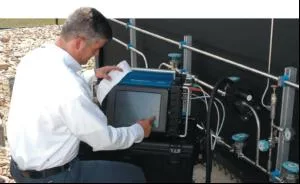
Today’s orbital welding systems employ a variety of
automated features to help welders complete accurate,
high-quality welds, and increase their likelihood of passing
in-process inspections. John Glessman, manager of welding
system product for Swagelok Company, explains
Passing in-process inspections for
orbital welding projects is critical, as a
failure can lead to costly rework,
project delays, and system downtime.
Automation can provide efficiencies for
welders and inspectors when conducting
those inspections.
Automated Documentation
Today’s orbital welding power supplies
automatically record the majority of required
welding data for projects. Automated
electronic data collection ensures that
searchable quality assurance data is available
to welders and inspectors so each party can
conduct in-process inspections in an efficient
manner.Welders are typically required to
maintain comprehensive data about each
weld in a project – a cumbersome process
that can account for 30% of total
construction labour hours when performed
manually.
Automated data collection captures all of
this data with minimal operator input,
allowing welders to focus on the welds. To
ensure complete data collection, some orbital
welding power supplies highlight required
data fields and do not permit welding to
start until operators fill in all open fields. In
addition, welders can provide
documentation data electronically to quality
control administrators. Proper data transfer
yields a higher probability of passing inprocess
inspections.
Electronic documentation data made
available to third-party inspectors expedites
in-process inspections. In an electronic
format, this data is sortable and searchable,
providing inspectors with valuable efficiency
during their reviews.
In-Process Inspections
Electronic documentation records also help
inspectors locate data faster compared to
leafing through hard copy weld logs. This is
helpful given the varying documentation and
in-process inspection requirements set forth
by industries, applications, and owner
companies. For example, the
biopharmaceutical industry typically
requires visual examination of every weld.
Welders must visually check the outside
diameter (OD) of welds and record this
information – sometimes along with a video
or image file.With welds chosen randomly
for examination, inspectors can quickly
search electronic records to locate specific
welds and their data. If a weld fails a test, the
inspector may search the electronic database
to find all welds performed during the same
period and review their parameters. Next, he
may perform additional testing on those
welds and potentially recommend rebuilding
that portion of a system.
In some cases, welding jobs require
intermediate in-process inspections at
specific milestones. Here, data automatically
stored on the welding power supply may
streamline the inspection. For example, a
particular code case for a nuclear project
requires inspectors to examine the welding
process every four hours. An inspector will
then verify that the welds meet the
inspection criteria and code requirements
before the welder can resume working.
Power supply data and alarm settings can
assist with the isolation and troubleshooting
of any weld in question.
In the semiconductor industry, inspectors
may check documentation data to confirm
the consistent operation of the orbital
welding power supply. Before completing
actual project welds, welders will ‘coupon in’
by performing a destructive test with a
sample tubing section and examining it
against specifications. This test becomes part
of the searchable electronic weld log and
serves as a baseline for subsequent welds.
Automated features
Newer orbital welding power supplies
provide complete, automated control of both
purge and shield gas. Purge gas controls help
maintain proper ID pressure at the weld
joint, while shield gas controls protect the
weld bead from atmospheric contamination
on the OD of the weld. Using an integral
mass flow controller, these systems adjust gas
flow automatically based on the weld program
to reduce the variability of manual control.
Some power supplies present detailed live
weld progress data to help operators better
evaluate welds. Graphics show progression,
performance levels, and stop/start for each
level of a weld in real-time. If the weld
deviates from the selected schedule, the
graphic will indicate points where those
variations occurred so the operator can
evaluate the weld after completion. This
feature enables welders to make efficient
adjustments to improve weld quality.
By leveraging automated orbital welding
power supply features, welders can enhance
their ability to create accurate, high-quality
welds, while also improving their efficiency
in collecting documentation data. Ultimately,
these automated features can improve the
likelihood of passing in-process inspections
and creating leak tight final systems.
IPE Newsletter
IPE publishes a weekly eNewsletter, delivering a carefully chosen selection of the latest stories straight to your inbox.
Subscribe here