

Belting solutions
The latest developments in conveying solutions technology
can deliver tangible improvements for the materials
handling industry, according to Richard Cole, materials
handling industry sector manager at Habasit Rossi
I
The latest developments in conveying solutions technology
can deliver tangible improvements for the materials
handling industry, according to Richard Cole, materials
handling industry sector manager at Habasit Rossi
In order to maximise plant output,
industry requires solutions that are
durable, reliable and built to withstand
the demands of today’s demanding
manufacturing environments, where systems
are often required to run for 24/7, 365 days a
year. The performance of conveying systems
can make a real difference to the overall
efficiency of materials handling plants and as
such, the industry as a whole stands to
benefit by re-assessing its current systems.
To maximise the potential output of a
plant, engineers must ensure that they select
the right conveyor belt for the right
application. They must look at whole life
costs, energy efficiency and maintenance, as
well as whether a belt is really suited to the
application for which it is intended.
Actual belt cost is always an issue – now
more than ever. However, increasingly, the
value of reducing whole life costs through
reduced maintenance and energy consumption
is being recognised. High performance, well
specified belts will result in far more efficient
production lines and reduce the amount of
unplanned production stoppages, minimising
losses in productivity and processing waste.
Using their industry specific know-how,
application engineers, technicians and
joining specialists are able to supply
professional consultation and support when
it comes to providing belting solutions
tailored to specific needs.
Selecting the material
Choosing the right technology can ensure
that a plant is working at its maximum
capabilities.Whether fabric, plastic modular
or power transmission, belts must be able to
offer reliability, an increase in system speed,
low noise operation, a short turnaround
time and system flexibility.
A wide range of high performance belting
solutions are available. For example, PVCcoated
fabric belts come in a wide rage of
surface types, structures and belt strengths
and offer good cost:value ratio, suitable for
ascending, descending and horizontal
conveying and merging applications.
There are non-woven belts suitable for
rugged conditions, as well as power
transmission belts, which are well proven in
live power drive applications and can be
tailor-made to meet specific needs. These
high efficiency flat and tangential belts are
suitable for high power transmission. Some
solutions provide energy savings of 6 to 8%
in certain situations due to their flexible
bending properties.
Timing matters
Designed for use in general conveying and
linear movement applications where exact
product placement and precise component
positioning is required, timing belts can
improve efficiency in a range of applications,
such as automotive assembly, furniture
manufacture, component assembly and pick
and place systems. Some providers offer
timing belts that have been designed for
applications where traditional belt options
are unable to provide performance
synchronisation. Precisely formed teeth with
accurate tooth tolerance and robust steel and
aramide cords, ensure consistent and exact
positioning of the product being conveyed.
Recent advances
The latest generation of plastic modular
belts, which are used in a wide range of
belting applications in materials handling
and general conveying, have been
manufactured with a variety of surface
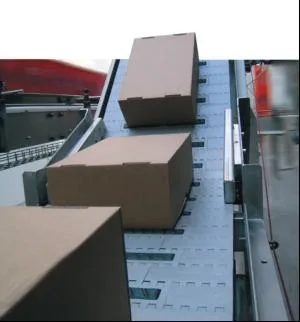
profiles to grip products such as boxes, travel
up steep inclines and maintain product
orientation.
There are plastic modular belts which
reduce product damage, downtime and
overall maintenance, which in turn provides
increased belt life and increased throughput.
The all- plastic design of these belts
promotes long life and efficient performance
in many applications.Multiple widths are
achieved by using a ‘bricklayed’ pattern,
which promotes lateral and diagonal belt
strength and stiffness.
Friction plastic modular belts can be used
in distribution centres, airports, general
conveyor systems, packaging end-lines and
checkouts. They have also been developed
with a variety of surface profiles to grip
products, such as boxes travelling up steep
inclines, to maintain product orientation.
Looking ahead
The UK materials handling industry faces a
real challenge to ensure it stays cost effective
and achieves high levels of sustained
productivity. Leading belt manufacturers
have developed products that will help ensure
production facilities run at optimum
efficiency to control costs, minimise
downtime and maximise productivity.
IPE Newsletter
IPE publishes a weekly eNewsletter, delivering a carefully chosen selection of the latest stories straight to your inbox.
Subscribe here