

Bridging a gap
Value Driven Maintenance builds a bridge between
traditional maintenance philosophies and managing by
shareholder value.Mick Saltzer of Mainnovation UK, explains
Afrequently heard question in
boardrooms the world over
Value Driven Maintenance builds a bridge between
traditional maintenance philosophies and managing by
shareholder value.Mick Saltzer of Mainnovation UK, explains
Afrequently heard question in
boardrooms the world over is: ‘What
is actually the added value of
maintenance?’ Even though maintenance is
critically important, few maintenance
managers are able to answer the question
convincingly. Especially when they are asked
to express the benefits in terms of economic
value added or shareholder value.
What is value?
Before you can manage by shareholder value,
you have to understand what exactly value is.
In theory, value is defined as ‘the sum of all
future free cash flows, discounted to today’.
Sounds impressive, but what precisely does it
mean? A cash flow is the difference between
income and expenditure. This is not the
same as the difference between revenues and
costs, because that’s an item that can be
greatly influenced by accounting practices.
The second part of the definition stems from
the knowledge that the value of a cash flow is
related to time. One euro is worth more
today than one euro next year. This is
because you can deposit a euro at the bank
today and use it to generate income over a
period of one year. Therefore, we have to
adjust future cash flows.
Value of maintenance
A maintenance manager is likely to say: ‘This
theoretical approach is all very well, but what
good is it to me in practice? The value of
maintenance comes from delivering
maximum availability at
minimum cost!’While this is
true in theory, it’s little help in
the day to day operation. This
is because you have to
prioritise: do you want to
reduce costs or increase
uptime? Is a 1% increase in
uptime as valuable as a 1%
reduction in costs? How do
you determine the value of
safety? Value Driven
Maintenance or VDM
provides answers by
identifying the value
potential of the four value
drivers in maintenance and
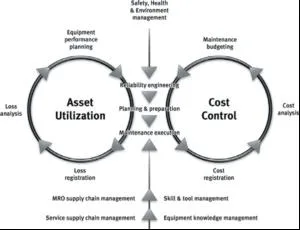
enabling you to manage by those drivers (see
figure 1).
Figure 1 shows what maintenance is all
about. Today’s maintenance managers are
constantly balancing between higher
machine availability (asset utilisation) and
lower maintenance costs (cost control). In
doing so, they must take into account safety,
health and environment regulations. To
make everything work, they need to use the
right technicians, spare parts, knowledge and
contractors (resource allocation).
For all four value drivers, maintenance can
help to increase a company’s economic value.
In a market where there is more demand
than supply, greater machine availability
results in more products, more income and
thus higher value. On the other hand, lower
maintenance costs produce higher value by
avoiding expenditure. The same applies to
resource allocation. One example is a
technical storeroom. Smarter inventory
management of spare parts can enormously
increase value for a company.
Similarly, the safety, health and
environment (SHE) factor affects value. SHE
accidents tend to necessitate substantial
expenditure, with resulting negative cash
flows. Damage caused to personnel,
environment and image, for example, will
increase expenditure. An even greater danger
is loss of the license to operate because of
inability to comply with SHE legislation. No
license to operate means no production and
no income.
Value potential
Maintenance managers must show where
there is potential for value within their
maintenance organisation. VDM provides
calculation models and tools for this
purpose. For example, in the bulk chemical
industry there is currently less demand than
supply and worldwide prices are under
considerable pressure. The value potential
here lies mainly in controlling costs and the
smarter deployment of people and resources.
Value and time
The next example shows that value depends
not only on the industry concerned, but also
on time and the market dynamics. In the
aviation industry, traditionally the focus was
on increasing fleet availability and meeting
the regulations of the Aviation Authorities.
As a result of 9/11, there was a reduction in
the demand for air travel. Thus, the focus
shifted from fleet availability to cost control
and required a complete change of thinking.
The economic climate, external factors and
market conditions will all impact on
determining which is the dominant value
drivers at any point in time – and the VDM
methodology will help guide the way.
Value and competences
Once the value potential has been identified,
the maintenance function must be organised
accordingly.Which competences are, and are
not, important? There will be little point in
giving priority to reducing the stock of spare
parts if the value potential lies in more
uptime. Unfortunately, we all too often see
that these decisions are not made by the
maintenance department. VDM does do
this, however, and it makes a link between
value drivers and core competences (see
figure 2).
Maintenance Core Competences
Take again the example of bulk chemicals.
The market situation means that most value
is currently achievable by controlling costs.
So the right-hand value circle must be
configured from maintenance budgeting to
cost analysis. Interestingly, both value circles
include the competences of reliability
engineering, planning & preparation and
maintenance execution. These competences
are the link between the four value drivers
and thus form the heart of VDM.
Value and best practices
Now that we know the important
competences, the next step is to organise and
control them in the right way. For this
purpose VDM puts forward best practices
from leading maintenance philosophies.
Total Productive Maintenance (TPM) enjoys
a reputation as the best practice for
registering, analysing and improving
production losses (asset utilisation) in
discrete production. In contrast, Asset Based
Costing (ABC) is a proven best practice for
properly controlling maintenance costs.
Using these, a technical department can
quickly become a professional maintenance
organisation that adds value to the overall
business performance.
Valuable?
Is VDM valuable? A growing number of
multinationals in Europe and the United
States think it is.Managing by value is not
just a must, it is the only way to discover the
true significance of maintenance.VDM
makes maintenance more than a cost centre
because it contributes in various ways to a
company’s economic prosperity.
In fact, Value Driven Maintenance
confirms what we already thought, but now
we have the proof!
IPE Newsletter
IPE publishes a weekly eNewsletter, delivering a carefully chosen selection of the latest stories straight to your inbox.
Subscribe here