


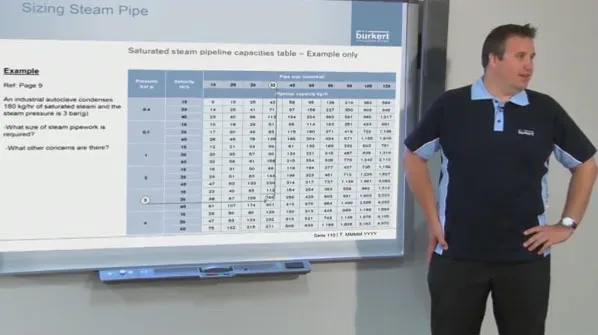
Bürkert free steam training covers the Top 10 things you need to know about steam and how to manage it safely & efficiently
Steam is used in a wide range of industries for a variety of processes, from a basic small heating circuit to large scale hygienic steam production. Greg Sutcliffe, Global Segment Manager at Bürkert looks at some of the basic principles that should be understood by maintenance engineers and facilities managers in order to achieve a safe and efficient process.
Modern production environments require the maintenance team to be
experts in a vast range of fields and while many areas may be adequately
covered, steam equipment can sometimes be overlooked. This can lead to
costly breakdowns or repairs which could have been avoided if some
basic principles were better understood.
 1. Velocity – Steam should be dry, and only minimal water
content should be the target, but it is often present as entrained water
and condensate. These phenomena can be damaging and wearing to the
steam system – particularly at high velocities. As a general rule of
thumb, pipe sizes are typically calculated using 25m/sec as the
reference speed. This forms a crucial part of the design, to reduce the
impact of water hammer, pitting and wear.
2. Water Hammer – Poor condensate management can lead to water
hammer; a condition that should never be tolerated. As the steam
travels over condensate in a steam line, it drags a ‘slug’ of condensate
along with it. Due to the mass and velocity of the ‘slug’ it can
contain large amounts of kinetic energy, which is dissipated when it
hits an obstacle such as a valve or pipe elbow. The results can be
mechanically destructive to plan and extremely dangerous to personnel,
so every effort should be made to design and maintain an excellent
condensate management regime and eliminate water hammer.
3. Installation of Strainers – Y-type strainers are needed to
protect expensive and process-essential equipment from damage and faults
due to debris in the steam. However, installed incorrectly they are a
potential source of condensate pooling and water hammer. When installed
in the steam line, y-type strainers should be installed NOT in the
‘belly-down’ position, but with the “belly” of the strainer in the
horizontal plane – an issue Bürkert has seen on several occasions while
fault finding on systems it has been called in to assess.
4. Pipe reducers – It may be necessary to reduce the pipe
diameter as part of the steam system design. On steam systems, it is
essential that eccentric reducers are used, rather than concentric
parts, with the flat side at the bottom. Concentric reducers have a
funnel-like profile and are sometimes installed by less informed
Engineers or when costs are being cut; however this will lead to pooling
of condensate and can be a prime source of water hammer.
5. Equal T’s – As a general rule, when installing a drain
pocket, it should be of the same pipe diameter as the steam main –
forming “equal T’s”, up to a size of DN100. If a smaller bore drain
pipe is fitted then the velocity of the condensate will allow it to skip
over the drain pipe connection. In addition, the reduced volume of the
drain pipe may cause it to overflow, thereby becoming another source of
water hammer.
6. Steam system materials – Particularly in legacy
installations, cast iron (gg25) pipework and equipment was used as the
standard material, which has been shown to offer certain weaknesses to
impact (including water hammer) when compared to other affordable
materials;– which could result in catastrophic failure. We recommend as a
best practice, to use spherical graphite iron (SG Iron) or stainless
steel (eg 316L), that can be up to 20-25 times more resistant to impact
than standard cast iron.
7. Isolation valves – A crucial part of the safety of the
steam installation is the isolation valve, which should be installed
both sides of steam trap sets to allow maintenance to be carried out
safely. More recently, industry has migrated to the use of double
isolation valves either side of the various pieces of equipment to
account for possible leakage past one of the valves and to ensure the
absolute safety of maintenance engineers.
8. Pressure gauges – These are crucial for providing
information required to understand the conditions inside the steam
system and they should be installed before and after a control valve to
ensure that the valve is performing as required. In addition, fitting
them periodically throughout the steam system will give early
indications of process change. This is crucial as variations in
pressure, and hence temperature, can lead to reduced plant productivity
and product quality.
9. Energy efficiency – Producing steam requires large amounts
of energy so reducing losses wherever possible helps to improve the
overall efficiency and reduce the operating costs of the system. In poor
examples up to 40 percent of the energy used to produce the steam is
lost, with failed steam traps accounting for 18 percent of these losses.
Regular testing and maintenance is crucial to ensure that the steam
traps function correctly. Further losses can come from the pipework
itself and this should be lagged properly, including pipe flanges and
all unused pipe-sections need to be isolated and lagged or better still
removed.
10. Above all else – RESPECT steam. As an odourless,
invisible, high temperature gas, steam can be extremely dangerous and as
such should be treated with great respect.
As part of its product offering, Bürkert has developed a range of
process control valves which can be equipped with the ELEMENT control
head as part of an intelligent, decentralised control system. In
addition, the experts at Bürkert can offer specific advice on selecting
the correct components for most steam process designs.
Bürkert has also produced a steam site guide with further information
on the design of steam systems, comprising 21 pages of very useful
information, including practical examples of various calculations and
can be found here or by visiting the Bürkert website, www.burkert.co.uk
For free copies of Bürkert’s Steam Site Guide, and for information on
Bürkert’s regular free Steam Training Courses, please contact Helen
Christopher, Bürkert UK Marketing Manager: Tel: 01285 648720 or E-mail:
[email protected]
Related posts

IPE Newsletter
IPE publishes a weekly eNewsletter, delivering a carefully chosen selection of the latest stories straight to your inbox.
Subscribe here