

Business expands with a new roofing sheet roll forming line
A new roofing sheet rolling mill production line has been installed and commissioned in Industrial Profiles’ Southampton Plant.
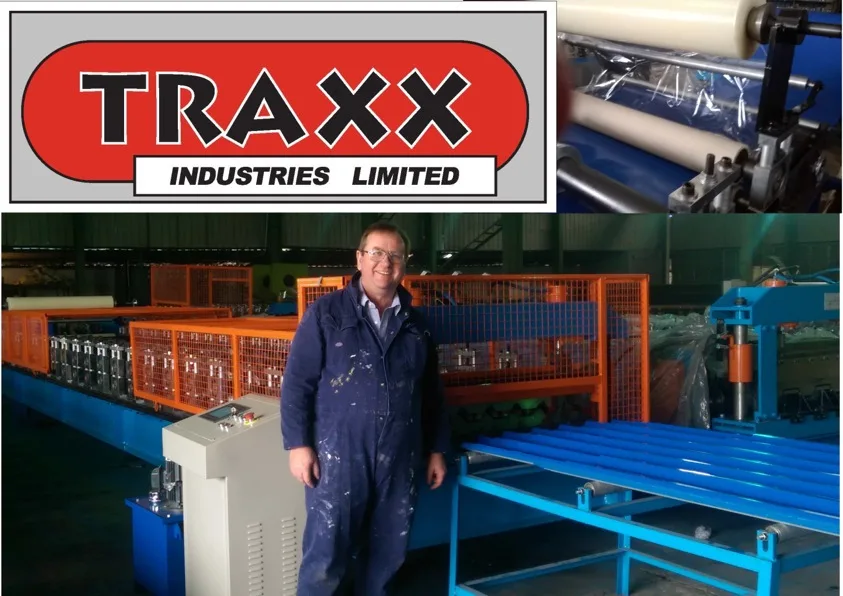
This new manufacturing capacity is based on the established cold rolled section technologies of Shanghai Maxwell Industrial Co, a business represented by Traxx Industries in the UK.
Industrial Profiles is run by Dale Marquer and other family members. With a wide range of production metalworking tools and powder coating facilities, the company
specialises in all the different profile shapes used in construction components, especially in the roofing industry.
Guillotines, press brakes and folders, although relatively fast tools for producing construction parts, have a cost and manufacturing time associated with them which is related to the skills, tools, settings and movement of parts through the machines. They are especially useful for flashings used in the roofing industry which the Industrial Profiles business has specialised in.
These machines can also on occasions be used to make roofing sheets and have the settings flexibility to make many different shapes. Many typical roofing sheets can be made on the fastest folders in Industrial Profiles works in about 8 minutes using two operatives to turn and rotate the guillotined part blanks. As the production batch size increases, however, the company says the folder loses its competitive advantage to faster manufacturing machines, like the cold rolling mill and is priced out of much larger volume work where rolling mill tooling can be justified.
Industrial Profiles contacted Mark Roberts, MD of Traxx Industries, to look into the feasibility of installing a roofing sheet rolling mill line in the existing works in the autumn of 2014. Traxx Industries had itself been interested in supplying rolling mills as a result of Mark Roberts’s early career in a black country rolling mill works where he had learned about this established manufacturing technology supplying storage equipment, cable support systems and higher volume sections into industries such as train/bus, coach building and trailer manufacture.
Industrial Profiles’s MD’s knowledge of roofing components had led him to believe that an advantage could be gained by developing a roofing profile with a slightly wider base coil section of 1250 as opposed to the 1220mm typically used on roofing sheet coils. Whilst more expensive coil with 2.5% more steel in it than typically used, the resulting profile is much stronger because the extra 30mm of width is used to create a supported bridge at the joint position resulting in greater assembled strength. Dale Marquer’s opinion was that roofers would prefer the extra strength and find it easier to assemble the roofing joints on buildings in construction. Dale Marquer decided that the 32/1000 trapazoidal profile had strong merit and would find many construction applications in new buildings as a result.
Traxx Industries simply drew up Dale Marquers specification on CAD before sending it to Shanghai Maxwell Industrial Co, for development of the set of 20 station roll tools to be deployed on an existing roofing sheet rolling mill chassis design, where a reliable machine system could be ensured in production.
The resulting rolling mill line features, with its primary set of 32/1000 trapezoidal rolling mill tools using a 1250 mm wide coil, high speed guillotine cropping at the end of the profile within tightly determined limits set by the rolling mills length measurement device controlled via a PLC in the control cabinet. Traxx Industries, keen to see an application for one its Maxwell rolling mills in the UK, agreed to supply two sets of top and bottom film application tooling to the line as part of the system.
The start of the rolling mill line features a 5t rated hydraulic decoiler which will clamp to the coils as they are loaded onto the rolling mill line before being drawn through the rolling mill in feed mode by the heavy motor of the rolling mill itself. Slight adjustment can be made to the sheet width position, enabling a cladding sheet to be produced from the same set of tooling as well as a roofing sheet. Whilst rolling mill lines are normally used for higher volume batches, the strong benefits of the PLC are that up to five sheet lengths can be programmed at once with five batch quantities so the resulting output can be quite flexible.
Further because the rolling mill line will initially simply be used for trapezoidal 32/1000 profile as primary output, small batches can be economically produced as well as larger batches. It is not until a rolling mill becomes used for multi-tooled section production that the issue of tooling changeover cost and time becomes an issue in the resulting component output costing. The colour of the resultant sheet is flexible, with the common range of colours used in roofing sheeting available for production such as Goosewing Grey 10A05, Merlin Grey 18B25 and Juniper Green 12B29.
A range of 0.5 – 0.9mm thick sheets can be produced in aluminium or zinc filmed steel, with 0.7mm sheet being the preferred thickness of production from ex stock coil.
The installation offers Industrial Profiles extra turnover growth potential from its existing established workforce with the line speed of the rolling mill set at 15 linear metres per minute.
The rolling mill line has some significance for Traxx Industries as well. It represents its biggest order by value to date.
The rolling mill line was installed and commissioned with help from Maxwell in China who flew in a commissioning engineer to assist. The hardest part of the installation was emptying the two containers of the rolling mill line.
One of these, the 40 ft container holding the rolling mill itself, required some clever fork lift truck movement which was achieved by shackling the rolling mill to a heavy fork lift truck which supported the rolling mill from beneath and then dragged it out of the container whilst still on the lorry before enough of the rolling mill was revealed, enabling two further forklifts to lift and support the rolling mill while the lorry holding the container drove off slowly, leaving the rolling mill supported on three fork lift trucks which then slowly lowered the mill to the ground. Geco Lift Trucks assisted with this part of the operation using heavy fork lift trucks.
The position of the rolling mill in the factory itself has been cleverly determined by the works foreman, Lea Marquer, who changed the original position from a central location in the works to an unused covered driveway. Using this layout position, the roller shutter doors are simply opened when a batch of production is required and the waiting trucks can be loaded straight from the company’s loading yard where a small canopy will be installed. This has freed up valuable production space in the factory which can be used for other manufacturing.
IPE Newsletter
IPE publishes a weekly eNewsletter, delivering a carefully chosen selection of the latest stories straight to your inbox.
Subscribe here