
Casting aside imperfections
With most casting operations one or more abrasive
processes are typically required to remove imperfections
and deliver the required surface finish.Richard Burn,
Abrasive Systems Division, 3M United Kingdom, explains
I
With most casting operations one or more abrasive
processes are typically required to remove imperfections
and deliver the required surface finish.Richard Burn,
Abrasive Systems Division, 3M United Kingdom, explains
Investment casting, also known as lost
wax casting, is an increasingly popular
method of manufacturing, particularly in
high value applications or where a high
degree of precision is required. The process
starts with a wax replica of the part required.
Several parts can be joined onto a central
fixture, which is then coated several times.
The resulting shells are heated to remove the
wax, leaving a hollow mould into which
molten metal is poured to create the casting.
Items as varied as automotive components
and industrial and gas turbine blades are
commonly made in this way. However, with
investment casting typically more expensive
than alternatives such as sand, die or gravity
casting, producing higher value, more
precisely manufactured parts, any subsequent
process must be equally precise to avoid the
risk of damage or loss of parts.
As with most other casting processes, once
the initial investment casting process is
complete, one or more abrasive processes are
typically required to remove imperfections
and deliver the required surface finish. The
abrasive process is integral to product quality,
with investment by leading players in the
market creating products to enhance
production quality and accuracy at all stages.
In fact, introducing abrasive processes can
help reduce cost in the manufacturing
process even before casting begins. A variety
of handpads are available to remove the
imperfections on the wax pattern to help
reduce the number and extent of abrasive
processes on the final casting.Meanwhile,
moulded radial brushes can be used to clean
wax deposits from the curing oven, with no
risk of flying wires.
Casting preparation
After cooling, the casting needs to be
removed from the central fixture using a
large cut-off wheel. The next process is stock
removal from the casting. This is usually the
most labour-intensive process and typically
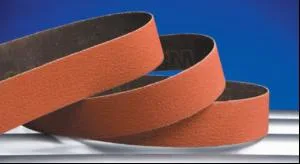
requires a heavy duty grinding belt.Many
companies invest in automatic or semiautomatic
equipment, with robots very
much at the fore to deliver faster results.
Advances in abrasive grain technology in
belts include, for example, 3M Cubitron
abrasive grain which sharpens as it wears,
resulting in faster cut rates and leading to
reductions in process times, cooler running
temperatures and longer belt life.
Finishing processes
In high-end applications where a premium
surface finish is required, a ‘highlighting’
process may be included. The aim of this is
to highlight and remove any small surface
defects, imperfections or inclusions on the
surface of the casting. 3M Scotchbrite
Surface Conditioning Belts can be used to
treat the whole casting in one or to work on
smaller areas.
Virtually all castings have a ‘skin’ which
needs to be removed, as will any platinum
pins and split lines in leading and trailing
edges, root end and around the ‘fillet’ on
turbine blades. This is best achieved through
the use of coated abrasive belts. Once again,
belts with a high cut rate and long life should
be specified to keep processing time to a
minimum, whereas a grinding aid will be
needed to deliver a fast, cool cut on heatsensitive
metals such as titanium.Medium
grade belts are available in varying degrees of
coarseness to deliver the required finish.
For intermediate blending and finishing of
split lines or aerofoils, or as an alternative to
surface conditioning belts for the
highlighting process, structured abrasive
belts should be employed. Research and
development in this area by 3M has created
Trizact Structured Abrasive Technology,
based on three-dimensional structures
containing multiple layers of abrasive, with a
new layer exposed as each structure wears
down to deliver a consistent, predictable
finish, with an even cut rate and long belt
life. These products deliver a high quality
finish, while in off-hand applications, they
can produce a higher cut rate than nonwoven
belts while maintaining the same
finish quality in more demanding
applications such as casting skin removal.
Surface conditioning belts can be used for
final blending and satin finishing prior to
polishing, shot blasting and other processes.
Radiussing and general deburring, and
finishing of leading and trailing edges on
turbine blades can be undertaken using nonwoven
wheels, which are available for exotic
metals, stainless steel or titanium. Scotchbrite
non-woven wheels are said to produce less
vibration and have a smoother running
action than rubber bonded wheels.
IPE Newsletter
IPE publishes a weekly eNewsletter, delivering a carefully chosen selection of the latest stories straight to your inbox.
Subscribe here