

Checking floodlight temperatures
When the sun comes out on a rainy Wimbledon match day, the roof over Centre Court can be retracted, but only after the 1000W floodlights, which are mounted on the roof beams, have cooled down.
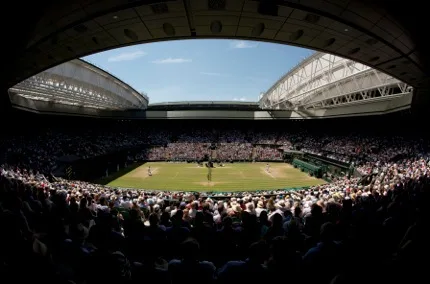
To check how soon the lights reach 100°C and the roof retract temperature, Galliford Try, the company that built the Centre Court for the All England Club, engaged the temperature profiling expert Datapaq. On an out-of-season day, Datapaq engineer Kevin Stephens performed a measurement run with three thermocouples mounted above and close to two lights. Connected to the sensors via 10 m trailing cables, a Q18-type data logger captured the temperature profiles with a 2 s sampling rate. Using a notebook and Datapaq’s specialised Insight software, Stephens read out and analysed the data, marking events such as ‘lights switched off’ or ‘sensor moved’. The test showed that the prescribed half-hour wait after the lights are switched off is necessary for safe operation.
Eugene McCormick, senior project manager at Galliford Try, notes: “We now have precise radiant heat temperature data. We will use this information when designing the roof for No.1 Court.” Datapaq supplied the full report, showing the temperature curves of all sensors over two and a half hours, during which the flood lights were on for nearly two hours and then switched off to cool down.
IPE Newsletter
IPE publishes a weekly eNewsletter, delivering a carefully chosen selection of the latest stories straight to your inbox.
Subscribe here