

Chiller challenge
Replacing an old chiller with a new one is a simple way to
cut energy use and carbon.However, as Steve Warnock MD of
Coolmation explains, there are many factors to consider
With recent technology developments
and impr
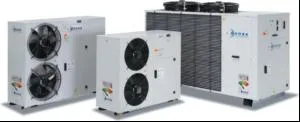
Replacing an old chiller with a new one is a simple way to
cut energy use and carbon.However, as Steve Warnock MD of
Coolmation explains, there are many factors to consider
With recent technology developments
and improvements in chiller design
and performance, replacing old
chillers with new, high efficiency ones brings
real cost benefits to the industrial sector.
Selecting the most energy efficient chiller
is not simple, and there is no one solution
that suits all. It is necessary to consider each
chiller’s EER (Energy Efficiency Ratio), the
ratio of cooling output compared to power
input. Eurovent, the European Committee of
Air Handling and Refrigeration Equipment
Manufacturers, has set its own formulae to
calculate EERs, making it easier to compare
the performance of chillers made by Euroventaccredited
companies. Its classification
for full load EER follows a similar path to the
A to G approach to the Energy Labelling
Directive, with the energy efficiency of
chillers designated by Eurovent A or
Eurovent B in catalogues and the Eurovent
Directory of Certified products.
Yet, a chiller’s EER should not be considered
in isolation. Reference to the chiller’s ESEER
(European Seasonal Energy
Efficiency Ratio), as set out by
Eurovent, will allow clients to
compare the efficiency of one
chiller against another under
part load conditions, giving a
more realistic view of the
chiller’s life-cycle
performance.
Since the compressor is
the largest energy consumer
within any chiller, the
choice of scroll, screw or
Turbocor centrifugal unit is
a key factor in defining the
EER and ESEER. Chillers
with the latest oil-free
Turbocor centrifugal compressors, with
inverter-driven, permanent magnet motor
and magnetic bearings, have grabbed the
headlines. Typically, traditional induction
motors of this size are in the 92% efficiency
range; the Turbocor compressor’s permanent
magnet DC motor provides an efficiency of
between 96 to 97%. Yet, they are not
necessarily the best option for all
applications. For tasks requiring cooling
capacities to 350-400kW, chillers with four
or six independently operating scroll
compressors are still likely to be the most
efficient selection.Matching a reducing load
simply means turning compressors off, more
efficient than allowing compressors to
continue to run in an unloaded
state.
The efficiency
of the
Coolmation
range of multi
scroll chillers has
been enhanced by
a predictive
control system,
which can
reduce energy
consumption by as much as 18% where
temperature stability is not so critical.
Traditionally, control logics on water
chillers and heat pumps ignore cooling load
dynamics; instead they regulate according to
return water temperature to maintain steady
operation. However, a new predictive control
system, Adaptive Function Plus, (developed
by Rhoss Spa and available from Coolmation
in the UK) is different since it objectively
optimises the chiller’s operation through
information gathered from the load profile,
then regulates delivery water temperature
according to load demands. A special adaptive
algorithm and mathematical formulae is
used to vary these values by managing the
operation of each individual compressor.
Rarely do chillers operate at full load
throughout the year in industrial plants,
and part-load operation has a noticeable
effect on seasonal energy performance and
power consumption. These are precisely the
conditions where efficiency savings can be
made through predictive control logic. A
predictive control ensures the highest
possible water leaving temperature is
delivered while still maintaining user
conditions. This can result in an 18%
energy reduction and proportionate
reductions in carbon footprint.
By using a predictive control it is possible
to achieve equal to or better performance
results than Class A chiller performance, as
defined by Eurovent, making it possible to
obtain an affordable, highly efficient chiller.
For applications where temperature stability
is essential to product quality, the AFP can
run on an alternative ‘precision setting,
making it possible to guarantee an average
fluctuation from the water supply temperature
of about ± 1.5°C from the set point value,
compared to an average fluctuation over
time of ± 3°C with a standard control.
Another feature of predictive control
systems is the ‘Virtual Tank’ function which
allows multi scroll chillers to operate with
less water volume per kW of cooling/heating
capacity. The control compensates by muffling
the control signal when source temperature
is reached, preventing the compressor from
switching on and off abruptly, saving energy
and reducing the average fluctuation of the
set-point value. Lower water content means
that, if required, a smaller buffer tank can be
installed, saving installation time, glycol and
water treatment costs.
Returning to chiller types, where demand
exceeds 500kW, the choice is probably between
a Turbocor or screw compressor chiller.Where
load conditions are going to be constantly
above 70%, it is probable that a screw
compressor chiller will be as efficient as a
Turbocor one, and less expensive.Where
loads are likely to reduce for considerable
periods to around 50%, Turbocor chillers
will be more efficient than screw.
Another way to cut a chiller’s operating
cost and its carbon footprint is to install a
free cooling chiller. This takes advantage of
low ambient temperatures to pre-cool the
water returning to the chiller, reducing the
load on the compressors and the energy
consumed.When ambient temperature falls
1°C below the temperature of the water
returning to the chiller, free cooling can be
activated. Free cooling is effective in the UK
where ambient temperature is below 15°C
for almost 75% of the year. Typically, with an
ambient temperature between 3 and 5°C
below set point temperature, compressors
will switch off and the only energy consumed
will be by the small fans on the free cooler.
To maximise either chiller efficiency or
temperature stability Rhoss’ AFP control can
now be combined with free cooling chillers.
Plant engineers must be given the chance
to select the most efficient chillers to meet
their requirements, while demonstrating
their financial benefits to finance directors.
IPE Newsletter
IPE publishes a weekly eNewsletter, delivering a carefully chosen selection of the latest stories straight to your inbox.
Subscribe here