

Clean and green
Aqueous cleaning of components can deliver excellent
results, has advantages for the operator and demonstrates
environmental responsibility, according to John Pattison,
managing director of MecWash Systems
Increasing
Aqueous cleaning of components can deliver excellent
results, has advantages for the operator and demonstrates
environmental responsibility, according to John Pattison,
managing director of MecWash Systems
Increasing competition demands greater
efficiency and consistently high quality
output from businesses, while fulfiling
environmental obligations. The importance
of environmental responsibility can often
move far beyond the obvious benefits, it can
even be a specific customer requirement
during the tendering process. In this context,
product and component cleaning is a key
focus. Cleaning installations not only have to
deliver excellent performance, but must also
demonstrate greener credentials. Increasingly,
many manufacturing and engineering
companies are looking towards aqueous
cleaning – not just because the concept can
deliver excellent results, but because it can
eradicate the acknowledged drawbacks of
solvent cleaning, not least for the operator.
Solvents Emissions Directive
MecWash Systems offers a choice of aqueous
component cleaning systems that can be
installed either as standalone units or within
a manufacturing line. Operating in a range of
engineering businesses worldwide, the shift
away from solvents that they enable does not
only reflect the drive towards quality and
environmental improvement, but also helps
users meet greater regulatory requirements.
“This was brought into sharp focus by the
advent of the UK’s Solvents Emissions
Directive in 2004 with particular relevance to
metal cleaning applications,” comments
MecWash managing director, John Pattison.
“The SED stipulated that all users of volatile,
organic compounds had to operate under
licence by the end of October 2007 and drew
particular attention to Trichloroethylene,
amongst other chemicals, which had been
widely used in cleaning applications.
“This has been emphasised more recently
when manufacturers and distributors agreed
with the EU Commission to sign a voluntary
charter not to supply Trichloroethylene to open
top degreasers after the end of 2010.As a result,
all such users would either have to invest in
expensive, hermetically sealed degreasers –
and still be subject to emissions checks and
future legislation – or move to other systems
such as aqueous,” he explains.
Similarly, alternative solvent n-Propyl
Bromide, which has been promoted as the
ideal drop-in replacement for Trike, has been
re-classified as a CMR (carcinogenic,
mutagenic or toxic for reproduction) – the
same category as Trike, and may also be a
priority for control or replacement under the
REACH EC Directive, which became
effective at the start of June 2007.
“From both environmental and production
quality points of view, we believe the argument
for aqueous-based cleaning has now become
overwhelming and, indeed, the success we
have enjoyed across our range of equipment
pays testimony to this view,” adds Pattison.
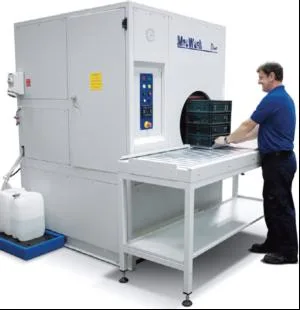
All MecWash machines are based on a
rotating drum within which products and
components are held and subjected to spray
and flood washing and drying processes. A
wide range of components can be
accommodated – from those loaded loose in
baskets to larger scale items held in purposedesigned
fixtures.
“Model selection is often dependent upon
the specific component or range of
components to be cleaned,” continues Pattison,
“but each can then be tailored to meet precise
application requirements. For example, we can
incorporate ultrasonic cleaning or direct
jetting – the latter, a reflection of the
increasingly widespread use of complex
components.” Here he highlights applications
in the aerospace, automotive and medical
industries as being particularly relevant.
“The machining of such components
unavoidably creates numerous areas where
swarf and other contaminants have become
trapped and the combination of our rotational
washing technology and highly focused jetting
action can often maximise the cleaning
performance. Specification requiring removal
of particle sizes of less than 100 microns –
common on complex engineering components
– can thus be readily addressed,” he continues.
Recycling system
The environmental benefits of MecWash
technology are enhanced by the use of a
purpose-designed wash water recycling
system from the company’s specialist
division, Aqua-Save Technologies. Aqua-Save
units can be specified in either a mobile
configuration or built into wash stations and
in all cases separate material for disposal
from re-useable wash water.
“As a result, typically only 5% of the wash
solution needs to be removed from site with
the remaining water clean enough, with
appropriate permissions, to be discharged to
drain,” explains Pattison.
With quality component cleaning such a
fundamental requirement throughout
engineering and with greater
acknowledgement of environmental
obligations,MecWash believes the argument in
favour of aqueous-based cleaning is becoming
ever more compelling.Where perhaps 15 or 20
years ago the use of solvents was regarded as
the principal option, their use is not only
becoming increasingly restricted through
regulations, but now has to be seen against
the performance capability of units such as
those manufactured by MecWash Systems.
“It’s a view that is being adopted by more
and more of manufacturing industry, both in
this country and overseas,” concludes
Pattison, “to such an extent that we believe
aqueous cleaning is now recognised as the
most logical and most viable option. From
both the production quality and
environmental stand point, that has to be
seen as a step in the right direction.”
IPE Newsletter
IPE publishes a weekly eNewsletter, delivering a carefully chosen selection of the latest stories straight to your inbox.
Subscribe here