

Combined solution to cutting costs
CHP is almost twice as efficient as a conventional power
station and can save some companies up to 50% of their
electricity costs, yet some organisations are still not aware
of the benefits. Marcus Dodsworth, manager of
S
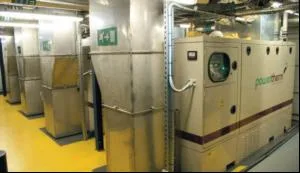
CHP is almost twice as efficient as a conventional power
station and can save some companies up to 50% of their
electricity costs, yet some organisations are still not aware
of the benefits. Marcus Dodsworth, manager of
Shentongroup technical service division, comments
We all want to do our bit for Climate
Change, right? We accept it may
sometimes mean spending money
to give long term benefits. And we’re happy
to splash out on carbon reduction
technologies even when it comes straight off
the bottom line of the budget, right? Wrong!
Why, I hear you say, should I spend cash
on carbon reduction when my first priority
is to meet performance targets and keep to
my budget? We agree. Energy costs have
risen more than a 100% recently and the UK
is bracing itself for further electricity hikes
and further legislation to cut the amount of
CO2 we emit. This issue isn’t
going to go away.
However much we
subscribe to the green agenda,
and however much we want
to act responsibly on climate
change, the truth is we have
to attend to our basic
business profitability first.
The good news is that
there are many carbon
reduction technologies that
will improve your
environmental standing
and pay for themselves.
A Combined Heat and
Power system (CHP), for
example, allows heat and electric power to be
generated at the same time from a single
packaged unit on site. A natural gas engine
drives a generator and ‘spare’ heat from the
engine, which normally would be wasted, is
absorbed by water through a special heat
exchanger. This hot water is connected to the
building heating system and supplements the
work of the boilers. Electricity generated is
connected to the mains incoming power, and
supplements or replaces power purchased
from the grid. As a rule of thumb, producing
1kW of electricity creates 2kW of usable heat
energy. CHP systems capture most of the
waste engine heat and turn it into useful hot
water, making it more than 84% efficient. It
also significantly reduces CO2 emissions.
Conventional power stations waste almost
all the heat energy produced. Furthermore,
there is a significant drop in power through
the grid network, called transmission losses.
In other words some of the electricity that
the power station makes never gets to you. It
is lost in the distribution system of the
national grid. So, not only is conventional
power generation inefficient, it produces
large amounts of CO2 in the process. The
power station is only about 30% efficient; a
further 5% is lost in transmission to your
site. From a carbon point of view, more than
0.5t of CO2 can be emitted for every 1MWh
of power produced.
You pay for this. Your electricity bill shows
no credits for heat wasted at the power
station or lost in sending the power to you in
the first place. And you pay a levy on the
carbon emitted by the power station.
Suppose you could generate your own
electricity? Surely this would eliminate these
losses? Suppose you could save the heat from
the process instead of sending it into the
atmosphere? Consider then, CHP, an
established technology that can provide a
reliable and cost effective energy supply.
The cost saving potential is attractive:
84% efficient means less money spent on
energy.
Located on site means no transmission
losses – what you generate is yours to use.
The gas used can be exempt from the
Climate Change Levy (CCL).
Reduce the use of your existing boilers.
Power-cut back up facility.
Manufacturing facilities, some hotels,
leisure centres, etc, all have sufficient demand
for space heating and hot water to use a CHP
plant, such as Powertherm. Some
manufacturers, such as Scorpion, can
synchronise multiple units to create an
efficient on-site power station that can
substantially reduce electricity bills.
There are three important criteria to
consider when contemplating CHP: The
ability to use the heat for heating or hot
water most of the year round; using a
reasonable amount of electricity to start
with; and the difference in electricity and gas
prices. CHP burns gas to produce cheap
electricity, so the ratio in these costs is key.
Here’s a yardstick. If your annual costs for
electricity are in excess of £200,000 and you
have a constant need for hot water, a CHP
system may be the answer. Savings and ROI
are impressive. Some installations are saving
£40,000+ per year. For example, a medium
size hospital would be a classic case where
medium size CHP is likely to be effective.
A CHP scheme such as a Powertherm can
considerably reduce your carbon footprint.
The Carbon Trust has 0% loans available for
up to 100% of the cost, to qualifying
companies. The loan is re-paid out of the
energy saving. CHP stabilises the risks
associated with rising electricity prices and
minimises the impact of the CCL. Good
quality schemes can also qualify for the
Government’s Enhanced Capital Allowance.
Energy industry leaders and government
ministers agree that CHP will play a more
prominent role in the United Kingdom’s
transition to a low-carbon economy. It is an
integral part of its target to set the UK on the
path to achieving an 80% reduction in
carbon dioxide emissions by 2050.
IPE Newsletter
IPE publishes a weekly eNewsletter, delivering a carefully chosen selection of the latest stories straight to your inbox.
Subscribe here