

Controlling voltage to control costs
Voltage optimisation (VO) can help companies cut both costs and emissions, as Jeremy
Dodge, business manager at Marshall-Tufflex, explains
Rising power bills and toughened
environmental legislation are forcing
UK manu
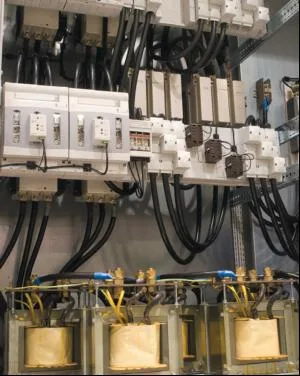
Voltage optimisation (VO) can help companies cut both costs and emissions, as Jeremy
Dodge, business manager at Marshall-Tufflex, explains
Rising power bills and toughened
environmental legislation are forcing
UK manufacturing and industrial
plants to implement energy-saving regimes,
with voltage optimisation one of the more
straight-forward technologies to adopt, as
demonstrated by two manufacturing sites in
the south of England.
Littlewood Fencing, a specialist barrier
and fencing producer, saw almost immediate
results after investing in a VO system,
reducing its power use by approximately
25% in the first five months post installation.
Not only did that equate to an average
monthly power saving of more than
4000kWh, with maximum load reduced by
more than 11%, it delivered another benefit,
as a company spokesman explained:
“Increasingly clients, especially those
working on large public and private sector
contracts, want to know what steps our
business – as their potential supply partner –
has taken to improve its environmental
performance. It is an increasingly important
part of the specification process and the
installation of the VO system is a clear
demonstration of our commitment to
environmental excellence.”
So, not only is the VO system reducing the
company’s CO2 emissions by approximately
40,000t per year and cutting its electricity
bills by up to 20%, it has
boosted Littlewood Fencing’s
environmental credentials,
providing an additional
competitive edge when
tendering for business.
Swimming pool
manufacturer Plastica has
also benefited from VO,
reducing its power bills by
approximately £12,000 per
year, allowing it to recoup
its investment within a
year. The voltage
optimisation system
designed for Plastica was
built on-site and installed over
several days. Final commissioning required
the site to power down and was therefore
planned for a weekend in order to minimise
disruption to the manufacturing plant and
company offices.
Both Littlewoods Fencing and Plastica
opted for the Voltis power saving system
from Marshall-Tufflex Energy Management.
There are a number of VO systems available
in the UK – Voltis is one of a new-breed of
systems with ‘logic-controlled’ intelligence.
This means it constantly monitors incoming
mains voltage supply and the power demand
of the site, adjusting itself automatically to
maximise efficiency, with power and carbon
savings of 15 to 20% achievable. Constant
monitoring also allows the system to
automatically switch to stand-by if mains
supply dips too low, safeguarding power to
site. This is achieved through a neutral
switching method so there is no break in the
power supply to site – the switch from save
mode to mains mode is seamless. This is a
more modern approach compared with
employing a more basic ‘step down’
technology which reduces mains voltage by a
fixed ratio and may cut power to site if
mains supply dips too low.Most older-style
systems generally return savings of around 8
to12%.
Why does VO work?
Why VO works is simple: The UK’s
electricity supply is set at a nominal 230V
(+10% to -6%). Therefore power supplied by
the National Grid can vary from around
216V to 253V but averages about 240V.
Equipment is designed to work most
efficiently at around 220V. Over-voltage
dissipates as heat and vibration within
machinery/equipment, reducing its
operational life (research suggests that an
over supply in voltage of 10% – ie 220V to
242V – can reduce the life of
electrical/electronic equipment by up to
90%). VO systems are installed in series with
mains electricity, reducing the voltage of
electricity fed to equipment and machinery,
for example from 242V to around 220V.
Electricity bills are reduced, carbon
emissions lowered and the life-span of
electrical equipment increased.
Select the right VO system and it will also
reduce maximum demand levels, refine
power quality by balancing the phases on
three phase supply, reduce harmonic
distortion (this is particularly the case of
three phase systems using single phase auto
transformers), suppress transients and
improve power factor correction.
When considering voltage optimisation it
is imperative to understand how each of the
systems works and to research the market,
asking questions and requesting proof of
fuel bill savings. Check other energy saving
methods installed at the same time as the
VO system, for example low energy light
bulbs and movement sensors, and ensure
savings figures are produced separately for
each energy saving element. Also take care if
developments are planned for your site –
mains supply levels may drop if new
facilities are added to the existing power
supply. Therefore your incoming voltage
level could drop naturally, which if you have
a fixed ratio solution in place could create
problems.
IPE Newsletter
IPE publishes a weekly eNewsletter, delivering a carefully chosen selection of the latest stories straight to your inbox.
Subscribe here