

Cool solution for trading desks
Ability Projects has partnered trading desk designer and
supplier DAS Business Furniture to supply desks with integral
cooling capability to a number of trading floors around the
world.Peter Lowther of Ability Projects det
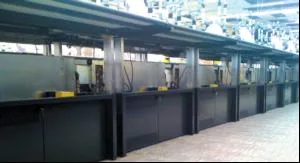
Ability Projects has partnered trading desk designer and
supplier DAS Business Furniture to supply desks with integral
cooling capability to a number of trading floors around the
world.Peter Lowther of Ability Projects details its role at One
Angel Lane, London, for Nomura
When the Nomura enquiry was first
raised DAS already had a cooling
system supplier but as enquiries
increased and the financial stakes grew ever
higher, it realised it needed a partner rather
than simply a supplier. This is where Ability
entered the equation. The brief at that time
was fairly basic and so while the final product
clearly would not be, there was a fair degree
of scope to tackle design issues in which ever
way looked best for the partnership.
Ability’s background is in fan coils, so the
cooling solution was always going to be a
variation upon a fan coil theme. However,
Ability was instrumental in the introduction
of EC fan technology to fan coils as well as
the first variable fan speed strategies and the
integration of BACnet control devices into
fan coils, so it was clear that there was scope
to design these elements into the solution.
The problem with cooling a trading desk
is the lack of space. Every trader needed to
have one to four computer units beneath the
desk, plus power and communications
wiring and a bank of up to eight flat screens
per trader. The final design incorporated a
special EC fan, coil, new BACnet controller
and new control strategy
A trading desk with a cooling module
needs to be sold on different levels – its look,
its practicality, ergonomics and the technical
capability of the cooling module it
incorporates.While Ability refined the fan
coil, DAS was involved in selling the features
of its desk to the bank. Having made it to a
shortlist of two, the next step was to test the
trading desks with their respective cooling
modules for performance and air distribution
and to see how each would interact with the
chosen environmental air conditioning
system. A test facility in Germany carried out
two days of intensive product evaluation. By
the end of day one, it was apparent that the
DAS desk and Ability cooling solution met all
primary requirements of the design brief.
Ability was pleased to have confirmation
that some of the additional performance
subtleties it had designed for were evident in
the noise and air distribution test data.
The Ability solution uses a variable speed
strategy driven by cooling demand; when the
trader or traders are away from their desks
and computer heat output is low, the fans
automatically adopt a set-back fan speed
condition, saving energy and reducing noise.
Conversely, when the trader returns, the fans
speed up to deal with the higher level of
demand. Over and above this, as the air
velocity also picks up, the cooled air stream
being driven up between the opposing banks
of trading screens induces air away from the
trader’s face, picking up heat as it passes over
the screens and delivering it unobtrusively
into the ambient space.
Some dealer CPU cooling solutions are
‘sealed’ in that they enclose the CPU area
and deal with the heat from the CPUs alone
while being isolated from the general space.
Ability bucked this style trend for reasons
which the tests confirmed to be correct.
An ‘open’ cooling solution is able to work
alongside the installed conventional air
conditioning. In the event that a single
‘closed solution’ trading desk cooling unit
failed, the CPUs inside the desk would be
isolated from any form of support and so the
temperature will rise rapidly. Conversely, if
an ‘open’ solution desk is struggling, fan coils
in the adjacent desks plus the normal air
conditioning will help out so that the impact
on the affected CPUs is barely noticeable.
The DAS / Ability desk and cooling
module combination have a BACnet terminal
controller as standard, enabling all trading
floor cooling modules to be networked and
potentially integrated into a conventional
BMS. It was only as discussions and meetings
progressed that it was realised how important
the uninterrupted running of any trading
floor is. This is why the ability to remotely
monitor and adjust each desk through the
BACnet network is so useful. This is also why
the ‘open’ design, which avoids downtime
during trading hours is key and why the
capability to ‘hot swap’ a cooling module out
of a run of desks in minutes is so important.
Ability desks are provided with a flexible
hose connection kit with quick release pipe
fittings. Should the need arise, this allows the
cooling module to be quickly disconnected
from the adjoining desks, removed and
replaced. The brief called for this procedure
to be carried out in less than 30min during
trading hours but as the ‘open’ nature of the
Ability module has the built in margin of
safety afforded by the support of its
neighbours, any servicing or replacement of
an Ability product can in practice wait until
the trading day is over.
Following the success of the One Angel
Lane project, DAS and Ability are supplying
and installing many cooled trading desk
solutions throughout the world. In addition,
several hundred conventional Ability fan
coils were supplied to both the base-build
contract and fit-out at One Angel Lane to air
condition the remainder of the building.
IPE Newsletter
IPE publishes a weekly eNewsletter, delivering a carefully chosen selection of the latest stories straight to your inbox.
Subscribe here