

Correct lubricants: Key to performance
Phil Burge, communication manager at SKF, looks at the
problems caused by incorrect lubricants and poor
lubrication practices, and offers a series of guidelines that
can be followed to optimise your equipment
Every en
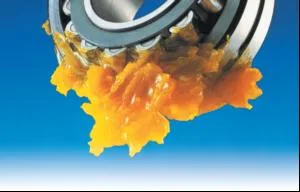
Phil Burge, communication manager at SKF, looks at the
problems caused by incorrect lubricants and poor
lubrication practices, and offers a series of guidelines that
can be followed to optimise your equipment
Every engineer knows that lubrication
is an essential requirement for all
moving components. However, the
evidence shows that this knowledge needs to
be applied with a little more care. Research
carried out by SKF indicates that around
36% of all bearing failures are due either to
the use of inappropriate lubricants or poor
lubrications practices. It is not enough to
assume that any kind of lubrication is better
than none and simply to apply which ever
lubricant is available. To extend the lifespan
and optimise the performance of equipment
it is essential to be aware of the problems
that can arise from incorrect lubrication and
make preparations to avoid them.
There are four key factors to consider:
Storage, Specification, Application and
Testing. A closer look at these factors will
reveal a series of guidelines that can be
followed to optimise equipment life through
effective lubrication.
Storage
Sometimes the lubrication process is
hampered before the engineer has even
begun because the lubricant on the shelf is
unusable. This may be because it has been
incorrectly stored in a contaminated or high
temperature environment that has
compromised its effectiveness. For example,
grease can harden or soften beyond the
limits required in these situations; it can also
oxidise or be subject to excessive oil separation.
The application of this lubricant is therefore
not going to give the machinery the required
protection.Worse still, if the applicator (such
as a grease gun or pump) is dirty, the
lubrication process may be doing more harm
than good; rather than protecting equipment,
the engineer is feeding in a substance that is
below quality for the task and adding dirt to
the system at the same time. So, make sure
you store your lubricant in a suitable location.
Specification
While engineers are aware that lubrication is
regularly required, they do not always apply
the correct type. Considering that investment
in components such as high quality precision
bearings is made to reduce failures and keep
machinery running smoothly, it is counterproductive
to then maintain these parts with
the wrong type of lubricant. Temperature,
speed and torque must be considered.Grease,
for example, can stiffen in low temperature
operating systems and evaporate in high
temperature systems, so lubricants that are
composed to cope with these conditions
should be used. Similarly, the speed of
movement within the machinery affects the
ability of a lubricant to form a barrier of the
correct thickness so, again, it is important to
use a lubricant of the correct specification.
Application
The time interval between each application
of lubricant can have a dramatic effect on
the efficiency of the system, as can the
volume of lubricant applied.Most engineers
are aware that insufficient lubricant can
bring a system to a standstill because without
lubrication the bearings will run dry and the
elevated temperature will cause machine
failure. However, it is also important to
remember that too much lubricant can
increase friction, increase temperature and
cause migration of grease into parts where it
can cause damage, such as electrical motors.
Testing
An effective method of checking that your
system is operating with the correct
lubrication is to use a diagnostic tool, such as
the SKF Grease Test Kit TKGT 1. During the
operation of machinery, the condition of the
lubricant will vary. Using a test kit, changes
in a lubricant’s consistency, oil bleeding
properties or level of contamination can be
checked and the results measured against a
diagram. The test can indicate what should
be done immediately to rebalance the system
and, over time, will establish whether
lubrication is being repeatedly mismanaged
and help engineers to be proactive in
improving lubrication practices.
By considering the problems that can stem
from inadequate storage, specification,
application and testing, many of the machine
failures currently caused by incorrect
lubrication can be eradicated
IPE Newsletter
IPE publishes a weekly eNewsletter, delivering a carefully chosen selection of the latest stories straight to your inbox.
Subscribe here