

Different design, yet same result
There are two main types of industrial rotary compressor
available – vane and screw. Here,Martin Chitty, business
development manager at Mattei, explains some of the key
differences between the technologies
Vane and
There are two main types of industrial rotary compressor
available – vane and screw. Here,Martin Chitty, business
development manager at Mattei, explains some of the key
differences between the technologies
Vane and screw compressors were
both developed in the 1950s, have
continually evolved since then and
essentially produce the same end result. But
this is where the similarities end, with the
two technologies differing quite considerably.
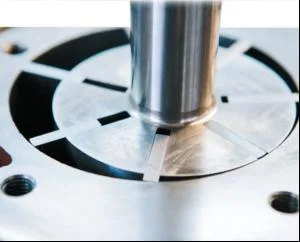
A rotary vane compressor comprises a
rotor with longitudinal slots, which house
individual sliding vanes. The rotor is offset
within a stator (a cylinder), in which it
rotates. While the rotor turns on its axis, the
vanes are pushed against the stator wall by
centrifugal force, and the air is compressed.
Meanwhile, a screw compressor has two
parallel rotors – a male and a female – which
engage into each other. These two rotors
intersect longitudinally with a critical
minimal clearance, and in turn are fitted into
a stator. During rotation, the profiles mesh
into each other, compressing the air.
Longevity and maintenance
These contrasting designs result in quite
stark differences – particularly where
longevity, maintenance and energy efficiency
are concerned. Vane technology is
particularly hardwearing. The use of a
quality lubricating oil means there is no
direct metal-to-metal contact between the
vanes and the internal stator wall, so there
will only ever be negligible wear on the
vanes. In addition, a vane compressor’s rotor
shaft is supported by simple white metal
bearings, which ensure a long and
inexpensive operating life. In fact, providing
a vane compressor is looked after in
accordance with the manufacturer’s
instructions, its operating life is virtually
unlimited, and maintenance is minimal. An
air end can easily run for 100,000 hours
without wear – in fact, some Mattei
machines have lasted over 200,000 hours, in
arduous operating conditions.
In comparison, I believe screw
compressors cannot offer the same levels of
longevity. Since the rotors on a screw
compressor need to operate with high thrust
and radial loads while maintaining
minimum clearances it is necessary for
manufacturers to use roller bearings. The
recommendation is for these bearings to be
replaced as part of the maintenance schedule
after as little as 20,000 running hours, but
this hefty cost is often overlooked at the time
of purchase.
Energy efficiency
For a compressor to operate efficiently, it is
essential for internal air leakage paths to be
kept to an absolute minimum; air lost during
compression equals lost energy.
In vane compressors, internal air leakage is
minimal, so they are volumetrically efficient.
The vanes move freely in their slots, but are
always in contact with the internal surface of
the stator (albeit not directly, due to
lubrication), so the air seal is near-perfect.
The clearances between the rotor, stator and
end covers are also efficiently sealed by oil
that is injected into the stator to lubricate the
moving parts and to cool the air during
compression.
In comparison, screw compressors have an
inherent ‘blow hole’, created at the point
where the external profiles of the rotors
meet. The air under high pressure returns to
the area of lower pressure through this
pathway. Manufacturers of screw
compressors have tried to reduce the ‘blow
hole’, but it is impossible to eliminate it
completely.
To compensate for these air leakage paths,
screw compressors need to run at high
speeds. In contrast, vane machines have
always operated at low speeds, from a direct
drive coupling, which in turn leads to lower
power consumption. Some of Mattei’s fixed
speed compressors operate at 1000rpm,
whereas the average screw compressor needs
to work at 3000rpm and higher to achieve
the same result.
Advancements in vane technology
There have been some major advancements
in vane technology in recent years. For
example, through developments in internal
lubrication and the rotor stator unit,Mattei
has been able to significantly improve offload
energy efficiency and on-load power
consumption respectively. The relatively high
oil carry-over of traditional vane
compressors has also been successfully
addressed. In Mattei compressors, the oil
quantity carried over is less than 3ppm as
standard, and with added filtration this can
be reduced to less than 1ppm.
Screw compressors currently have a large
market share, but it shouldn’t be assumed
they are superior to vane compressors. In
fact, we’d argue that the widespread use of
screw compressors has more to do with the
machinery being easier to replicate than
technological advantage.
IPE Newsletter
IPE publishes a weekly eNewsletter, delivering a carefully chosen selection of the latest stories straight to your inbox.
Subscribe here