

Different loads, different needs
Broadly, lifts fall into two categories – passenger lifts, and
goods-only lifts. Their names are self-explanatory, but
because of their different loads, there are different health
and safety requirements, as Mike Carp, sal
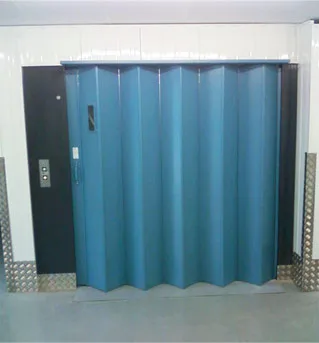
Broadly, lifts fall into two categories – passenger lifts, and
goods-only lifts. Their names are self-explanatory, but
because of their different loads, there are different health
and safety requirements, as Mike Carp, sales director at
DeSeM Lifts, explains
Passenger lifts have to be fitted with
‘sinking car’ arrest gear, which is
designed to prevent uncontrollable
descents. They must also be assessed by a
Competent Person at least twice a year. This
is an independent party, who thoroughly
inspects the mechanical workings, such as
the door locking system, safety gear, and
overload detection devices.
The assessment, which is a stipulation of
the Lifting Operations and Lifting
Equipment Regulations (LOLER) 1998, is
aimed to detect any defects which are or
could become dangerous. These should then
be reported to the dutyholder – the lift
owner, or the facilities manager or supervisor
– so that appropriate action can be taken.
The Competent Person assesses the risks
based on several criteria including where and
how much the lift will be used, the age and
condition of the lift, and the weight of the
load to be carried. Usually they are
appointed by an insurer, and they must have
enough technical and practical knowledge of
lifts, and be sufficiently independent and
impartial to make an objective assessment.
Therefore, it should not be the same
person who carries out maintenance work on
the lift, because they would be assessing their
own work.
If in doubt, ensure the Competent Person
(CP) has the relevant BS EN ISO/IEC
17020:2004 accreditation, as this
demonstrates their competence in carrying
out assessments.
Having completed the audit, the CP
provides a report within 28 days, or sooner if
there are problems which need to be rectified
quickly. This will summarise the inspection,
specifying the safe working load of the lift,
identifying any defect, and giving details of
any action required. It should also provide
the date of the next assessment.
Dutyholders are legally required to keep
reports available for at least two years, for
consideration by health and safety inspectors
if necessary. These requirements are specific
to passenger lifts and are designed to keep
passengers safe.
The rules for goods-only (GO) lifts are not
as stringent, because people are not supposed
to use them. However, that is not always the
case – there have been many examples of
people being rescued from goods-only lifts.
Preventing problems Most GO lifts don’t have the arrest gear,
which means if people are using it to travel
between levels, they are in danger of being
involved in an uncontrollable descent. This
can cause serious injury, or worse.
Furthermore, if the lift becomes stuck, an
engineer’s work to free passengers will be
precarious, because the lift could drop at any
time. In many cases, the engineer will
assume there are no passengers and simply
look to free the lift.
In our view, all lifts should have the arrest
gear, to prevent incidents like this occurring.
We cannot assume that people have paid
attention to warning signs and avoided using
a GO lift. At the moment though this is not
required by law.
To try and address the issue, regulations
stipulate that warning signs should be
displayed clearly around goods-only lifts.
These signs must be unambiguous and not
defaced. People do occasionally ignore the
signs, but if a dutyholder provides them, they
should not face problems in the event of an
insurance claim.
Another option is a self-rescue system,
which many modern lifts are fitted with.
However, these are not always reliable,
particularly if they are not properly tested
and maintained.
They become less effective with age, and
there are several cases on record of older
self-rescue systems not being effective.
Emergencies
Where there is a passenger-carrying lift on
site, it is recommended that there is a
nominee trained in emergency passenger
release on that specific equipment, to save
waiting for a lift engineer to attend to release
them. An engineer still has to sign off the lift
to return back to service following a ‘trap-in’.
The emergency services are the building
owner’s last port of call as they are not lift
engineers, and could cause serious damage
to the equipment in attempting efficient
passenger release. In many cases the they will
raise invoices for turn-outs like this.
Depending on the types of passenger lift,
two engineers may be required to effect a
safe passenger rescue.
It is vital for any passenger lift on your site
to be regularly CP assessed. Insurers will be
reluctant to cover the owner if this is not
done. Failure to do so could have serious
financial implications in the event of an
accident.
IPE Newsletter
IPE publishes a weekly eNewsletter, delivering a carefully chosen selection of the latest stories straight to your inbox.
Subscribe here