

Don’t throw money out with the waste
UK manufacturers need to be more efficient in how they
recycle metal waste or continue losing millions in potential
profits each year, according to the findings of a new report.
One of the companies acting to cut its was
UK manufacturers need to be more efficient in how they
recycle metal waste or continue losing millions in potential
profits each year, according to the findings of a new report.
One of the companies acting to cut its waste is Honda
The ‘What a Waste’ report by
Nederman focuses on the practices of
metal machining manufacturers such
as those making components for the
automotive or aerospace sectors, or producing
consumer goods. The report demonstrates its
findings across five typical scenarios,
revealing that the average business is losing
from £172 to £780 on every tonne of metal
waste it recycles, representing many millions
in lost profit for UK manufacturing sectors.
Nederman reports that while recycling
levels are strong, with companies recognising
the value in scrap metal, they are failing to
properly appreciate its true potential value.
Nick Dulley from Nederman UK explains:
“Companies need to appreciate that recycling
in itself is not enough to maximise
profitability. By handing over unprocessed
metal waste to recycling companies they are
potentially handing over a significant
amount of their potential profits.
“By improving the efficiency of their
recycling processes, they can achieve a much
higher price for the metal swarf they produce
as well as reclaiming valuable coolants and
cutting their transport costs.”
When Honda of the UK Manufacturing
(HUM) turned to Nederman to increase the
ROI in its swarf purification system, it
needed a partner that could drive huge
efficiencies, slash costs and improve
revenues. Waste in the automotive
manufacturing sector is a major business
issue but, due to the increasing value of
reclaimed materials, recycling and closed
loop waste reclaim systems are big business.
At HUM, no stone is left unturned. A single
factory, such as the engine plant in Swindon,
generates over 1000t of swarf waste annually,
so increasing efficiencies in production
recycling is critical to the bottom line.
Waste aluminum has huge financial value,
which is increasing all the time, yet there are
still many manufacturers that are not
running efficient production recycling
systems. HUM is aware of the value of this
waste and aimed to create systems and
processes that ensured every last gram of
aluminum was recycled.
Automotive grade aluminum from a
machining plant is often impure, covered in
grease, oil and coolant. The waste from the
machining process is also often bulky swarf
that is difficult to clean and costly to transport.
Many manufactures are shipping this raw,
unprocessed waste from their sites to
reprocessors by the lorry load, at a greater
cost. The challenge is how to turn cost into
profit, by streamlining the process, increase
the value of the material by removing
impurities, and reducing travel costs.
A solution
Rather than send swarf waste off site for
reprocessing, Nederman’s solution is to clean
all the material onsite, separate the tramp oils
and fines from any coolant and purify it by
separating the aluminum from ferrous
materials. Once this process is complete the
material is compacted via a briquetting
process, so it is easier to handle and
transport by the lorry load.
Nederman says this means that greater
volumes of material are reclaimed and
manufacturers see a greater return on the
value of their materials. Over a short period
of time – perhaps 12 to 18 months in some
circumstances – the cost of the solution is
more than covered in the increased revenue
from the reclaimed material.
Other benefits include: reduced downtime
through keeping the production process
clean, preventing the inefficient removal of
swarf from causing a production line to slow
or even shut down. For HUM, Nederman
provided a system that can purify and recycle
swarf to very high standards.
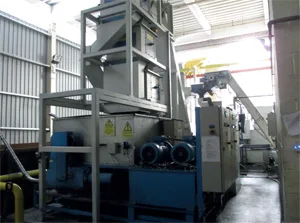
Shredding: HUM was producing 1000t of
swarf waste a year, which is one to two lorry
loads a day. This waste had 20% moisture
content and 5-15% ferrous content. The first
step was to shred the swarf into a more
uniform chip which was easier to process.
Centrifuging: The chipped swarf is passed by
conveyor to a centrifuge for removal of the
moisture. This stops it clumping together
and adds in the ferrous removal process.
Moisture, which contains coolant and oils
from the cutting process, is passed to a
separate processing unit.
Magnectic removal of ferrous material: The
aluminum is passed over a multi-stage set of
magnetic rollers to remove the ferrous
particles from the swarf. The larger ferrous
debris is removed by a natural earth magnet
before being passed over a raw earth magnet
to remove all traces of ferrous particles. The
waste at this point still has high aluminum
content and needs to be processed again. It is
passed over a natural earth magnet to
reclaim any excess aluminum from the
waste, reclaiming over 99% of the aluminum
with less than 0.25% ferrous remaining.
Reclaiming coolant: The coolant is also
reclaimed and where possible reused or
recycled. Water and oil are separated and
where possible reused in the manufacturing
process or sent for recycling.
Briquetting: Once the aluminum has been
reclaimed from the production system, the
materials were briquetted to reduce their size
before being transported to a reprocessor.
The outcomes were impressive and more
than paid for themselves: Average revenues
from the swarf sold increased three-fold.
HUM benefits by reducing the amount of
lorries needed, revenues from recycling
coolant increased, and the cost of the
complete system was paid back in less than
24 months.
Related posts

IPE Newsletter
IPE publishes a weekly eNewsletter, delivering a carefully chosen selection of the latest stories straight to your inbox.
Subscribe here