

Doors into the future
Be it the silky smooth glide and characteristic ‘shush’ of the
Starship Enterprise’s internal doors or the self-satisfied,
smugness of their operation on Zaphod Beeblebrox’s Heart
of Gold, science fiction writers have long
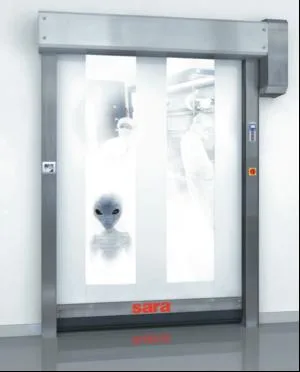
Be it the silky smooth glide and characteristic ‘shush’ of the
Starship Enterprise’s internal doors or the self-satisfied,
smugness of their operation on Zaphod Beeblebrox’s Heart
of Gold, science fiction writers have long felt that, for doors,
the future holds many possibilities.Here Ed Wilks of sara
LBS, examines the advances in real door technology
Over the last 20 years the technology
that has been available in industrial
doors has developed to allow users to
specify their needs to an exact science.
Extremely fast operating speeds are now
available with smooth operation and safety
features that exist to prevent doors closing
on obstructions or personnel. Doors can be
operated using many different methods and
even integrated into
a fully automated
system when
required.While
there have been too
many advances to
cover them all in
great detail, there
have been a few that
stand out as having
brought the future
of doors to the
present.
In industrial
environments that
rely on efficiency and organisation, a door’s
operating speed and reliability can play a
large role in meeting daily targets. In the past
doors had limited operating speeds as high
speeds could create vibrations which would
cause damage and decrease operating life.
Now, using tensioning technology and
smooth acceleration techniques, doors are
able to operate at speeds that have made
bottle-necking a thing of the past.
The MCC Vector Control system from
sara LBS is an example of one such system
that has led to operating speeds that can
reach 3.2m/sec. The intelligent door control
system uses vector control technology to
ensure that the door accelerates and moves
smoothly, even at high speeds. As well as
improving the performance and life of the
doors the MCC system offers a high level of
operational freedom; different operating
speeds and closing heights can be
programmed in to account for different
cargo loads.
With doors operating at higher speeds,
safety features have developed to protect
personnel, equipment and goods from
damage in the event of doors closing at the
wrong time.Many doors use contact safety
edges that reverse upon light contact with
obstructions; while this reduces the risk of
serious harm to personnel it can still cause
minor injuries and damage to products.
sara has developed a safety system that
completely prevents contact with any
obstructions. Known as the non-contact
safety beam, it uses pre-running photocells, a
beam that detects any obstructions and
reverses the closing doors; the photocell runs
an inch below the closing door allowing it to
begin closing as objects pass through it in
environments where the door’s opening time
needs to be kept to a minimum.
As safety levels and reliability have
improved it has been possible to increase the
automation of doors. There are a number of
methods by which doors can be remotely
activated; from push button operation to the
use of remote transmitters which open to
authorised personnel upon approach, and
non-touch activation pads which are suitable
for cleanroom environments where
contamination risks are high.
Automatic opening is available using
photo-cells to detect proximity, in a similar
style to sara’s non-contact beam, or a radar
mounted above the door to detect
movement.
Special opening systems can be designed
where needed. For example an air lock
system can be created, opening two doors in
sequence, shielding protected areas from
external environments. Doors can also be
fitted with traffic lights and warning lights to
improve functionality and safety.
As the safety and functionality of doors
have improved a number of other features
have developed to allow the user to specify a
door that is suited to their need. Such
features include; wind resistance, up to
hurricane force; bottom rail stoppers that
prevent the bottom rail rising if pushed, and
vermin control; curtain tensioning that
powers doors in both direction, providing
better operational balance.
With such a variety of options available it
is important to speak to an expert who can
help to develop the right solution for every
scenario. sara, for example, provides the
services of trained sales engineers at every
stage of the purchasing process – from the
original quote to after-sales services.
IPE Newsletter
IPE publishes a weekly eNewsletter, delivering a carefully chosen selection of the latest stories straight to your inbox.
Subscribe here