

Driving forward a holistic approach
Variable speed drives (VSDs) can play an active role in the
improvement of energy management within an organisation.
However, they are just one element of the automation
system, as Paul Pryor of Schneider Electric explai
Variable speed drives (VSDs) can play an active role in the
improvement of energy management within an organisation.
However, they are just one element of the automation
system, as Paul Pryor of Schneider Electric explains
Achieving efficiency in production
plants is among the most
challenging issues faced by today’s
manufacturing industries, with energy
management and environmental protection
high on the agenda. Essentially, both can be
achieved by gaining full control and
visibility over a plant. Variable speed
drives are typically used to control
pumps and fans and offer massive
potential to help plants reduce energy
use, prevent downtime and limit
unplanned maintenance. Yet despite
their energy saving benefits, it is
estimated that just 10% of pumps and
fans in industry are driven by VSDs.
When it comes to looking at the
scope of automation within a plant
environment and how VSDs fit into
this approach, businesses need to
consider the integration of each
component in its own right. For
example, VSDs were typically
thought of as analogue devices,
connected into a system using
analogue and stop start signals.
However, product development has
meant there is now a trend towards a more
simplified approach as one communication
wire can do the job. It is also now possible
to pull more information from the VSDs,
which feature monitoring and diagnostic
capacity, providing users with more control.
This enables an organisation to reap the
benefits of a more efficient and sustainable
plant.
There has also been a move away from
centralised systems. Gone are the days when
VSDs had to sit in a central panel with PLCs
and the controls. The ability to use
communications with IP54 rated drives
means users can place the drive local to the
motor it is controlling, with communications
information running back to a centralised
control and monitoring system. For example,
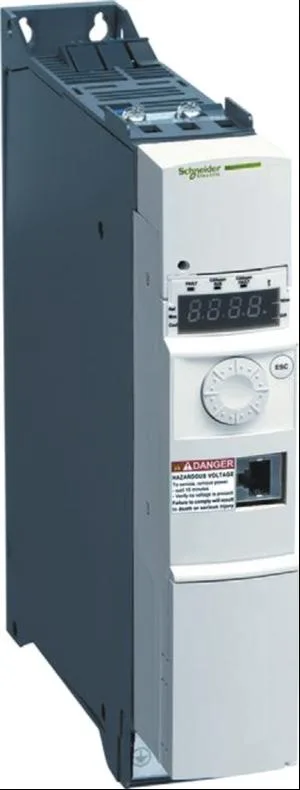
Schneider Electric’s new Altivar VSDs have
embedded CANopen and Modbus and can
communicate with most industrial networks
for complex and automated applications.
Networking VSDs together with other
motor control instrumentation via a fieldbus
network will allow plant managers to
diagnose problems from one central point.
Information gained can help ensure VSDs
only run at the required speed so that energy
is not being wasted. For example, it is quick
and easy for the plant manager to change the
speed of a fan or on a production line, alter
the volume of fluid going into a bottle.
Businesses can be flexible in the design of
their factory and production lines and benefit
from a more compact set up – important for
any energy-conscious organisation, as it
enables the plant manager to control the
entire premise remotely, allowing easy
identification of where energy is being wasted.
Greater efficiency can also be achieved
through the use of Human Machine
Interfaces which are widely used to gain
interaction with the entire automation
system, an individual machine or a specific
application, therefore giving the power to
control any element within the plant’s
architecture. From the system data, it is
possible to monitor the plant’s energy output
and any fluctuations can easily be identified.
This means drives that are not achieving
optimum efficiency can be pin-pointed onsite
and remotely via data sharing and web
gate technology. Data sharing is the
synchronisation of systems within the whole
process. By networking, access to the data
and information can be acquired by anyone
with permission. To take this one step
further, web gate technology could be used
to achieve complete remote monitoring. This
is where processes can be monitored from
anywhere in the world and at any time, by
connecting remotely via the internet.
When it comes to implementing an
integrated automation system, businesses
must consider the number of devices that are
being connected and the central intelligence
they are connecting to. It is always going to
be easier to integrate the solution in a new
build situation, but as the emphasis has
shifted to existing premises to improve their
energy efficiency to help meet environmental
targets, organisations need to consider how
they can implement a central communications
system into an existing plant structure.
Using existing cabling may mean that
users only have access to limited information
from the field and process devices, so it is
important not to overlook the need to
replace existing cabling infrastructure to make
it possible to get the level of information and
detail the devices such as the VSDs can
provide. Another option that businesses can
consider is wireless connectivity, but this
technology is still in its infancy. However,
businesses can consider adopting it when the
time is right, as it will provide a future-proof
solution that can be expanded.
Escalating manufacturing costs and a
difficult economic climate have made it a
business necessity to improve overall
operational efficiency across all
manufacturing facilities. And, while VSDs are
ideal for achieving different operating speeds
for each process, in turn reducing energy
consumption, they need to be viewed as one
element of an integrated collaborative
control system, providing businesses with a
holistic approach to managing their plant.
Related posts


IPE Newsletter
IPE publishes a weekly eNewsletter, delivering a carefully chosen selection of the latest stories straight to your inbox.
Subscribe here