

Driving forward green issues
Loans now available through the Carbon Trust effectively
make variable speed drives free of charge.However,some
potential users fail to understand the simplicity of their
installation and the benefits they bring to machine
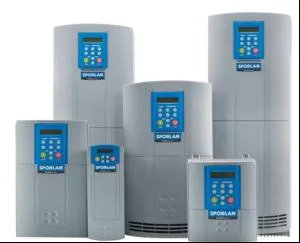
Loans now available through the Carbon Trust effectively
make variable speed drives free of charge.However,some
potential users fail to understand the simplicity of their
installation and the benefits they bring to machine operation.
Andy Parker-Bates of Parker SSD Drives, part of Parker
Hannifin, helps fill in some of the blanks
About 70% of all the electricity
generated in the industrial world is
used to drive motors, and these are
often parts of hugely inefficient machines
and systems. The wastage of
power is almost beyond
calculation. Reducing this
waste is becoming a moral
imperative because of global
warming and is increasingly a
financial necessity as markets
become more and more
competitive.
Variable speed drives offer
a simple solution to this
problem. Easy to fit and
self-tuning, they constantly
adjust the output speed of
the motor to exactly match
the needs of the application,
speeding up and slowing
down in real-time as power
demand varies. The energy savings can be
enormous because wastage is proportional to
the square or cube (depending on
application) of excess speed.
A fixed speed machine or application has
to be set to a speed that will cope with worst
case scenarios, plus a margin of error. A
secondary mechanism is then used to cope
with the excess. For instance, a ventilation
fan would use louvers to divert excess flow,
while a pump would use valves to recycle
surplus volume.
In contrast, a drive on the motor would
speed up and slow down the fan or pump to
meet actual demand. It should be noted that
a drive could be used in a fixed speed mode
to say set a conveyor belt’s speed, or in a
constantly variable mode where it is dealing
with intermittent machine usage or load
matching to a varying demand.
Installing drives is not particularly difficult;
they usually fit within existing control
cabinets.Most need setting up to meet the
needs of their particular application; 10 or 15
years ago this could be difficult and time
consuming, but these days it is effectively
transparent. The software within the drive can
be set to meet given applications, pump, fan,
lift, hoist conveyor; it is then run in ‘autotune’mode
to pick up the main parameters
and operating cycle of the application.Within
minutes it can be bedded-in to the
application, enhancing operation, saving
energy and improving competitiveness.
Energy grants
The energy saving potential of drives is
enormous, yet only 10-20% of motors that
could benefit from drives are currently fitted
with them. This figure is so low that the
government want to encourage further take
up, thus reducing national carbon output
significantly. To do this, it has authorised the
Carbon Trust to offer loans for drive
installations, whether new-build or retrofit.
The purchase price of the drive can be
borrowed and repaid at a rate that matches
the energy savings, so it is effectively free of
charge. Information is available from the
Carbon Trust’s website. Applications can be
made online. In some cases the supplier can
submit an application on a customer’s behalf.
It is worth noting that many drives will
pay for themselves in less than 12 months,
almost all of them within 18 months, but the
repayment period can be up to 4 years. Also
most drives run for 5 to 10 years, meaning
energy cost-savings long after payback.
Energy saving is only one of many benefits
for drives. Another use is load matching. An
uncontrolled motor will slow down as the
mass it is moving increases, unacceptable in
many lift and hoist applications. Imagine a
20 person passenger lift in a skyscraper; if
the lift car were full, say at 8:55am when
people are rushing to work, it would move at
5% speed; an hour later when one person
wanted to go up a couple of floors it would
be like a jet fighter! The same principle
applies to hoists in industrial environments.
Similarly, a conveyor feeding, for example,
manufactured goods from production to
packaging can only be matched to
production rates if there is a drive resolving
speed and load calculations. Another
common application is speed profiling in, for
example, a centrifuge. This may start from
zero, accelerate slowly to a first fixed speed
for a set time, then accelerate rapidly to a
second fixed speed for a period, and finally
decelerate moderately back to a stop.
In summary, plant engineers should assess
all motors for drive fitment to see if they
could benefit from the advantages offered by
today’s variable speed drive technologies.
Fleet control
IPE Newsletter
IPE publishes a weekly eNewsletter, delivering a carefully chosen selection of the latest stories straight to your inbox.
Subscribe here