


Dust extraction: Benefits all round
Whether handling or processing powdered or granular material, cutting, forming,
machining or finishing products, or indeed packing and marshalling finished products, dust
may be released into the atmosphere. Gus Bishop, for
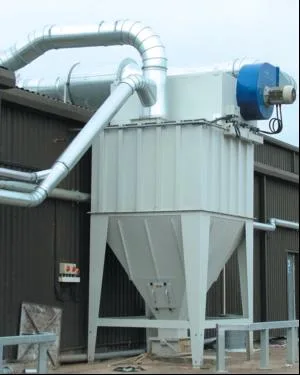
Whether handling or processing powdered or granular material, cutting, forming,
machining or finishing products, or indeed packing and marshalling finished products, dust
may be released into the atmosphere. Gus Bishop, for Nederman, outlines a solution and
explains the benefits it brings – not just in terms of health and safety
While an employer is obliged by law
to provide a healthy atmosphere
for the workforce, the
opportunity should be taken to make the
most of the several other benefits available.
For example, general maintenance
requirements will be reduced; product
quality may (and probably will) be
improved; absenteeism of employees may
well be reduced and also turnover of staff.
Employees who feel that their environment
and welfare are uppermost in the minds of
their employer are more likely to be
committed and remain loyal, bringing a
further bonus of reduced cost in recruiting
and training new operatives. The plant will
be more attractive to visiting customers and
prospective customers, so that good dust
control even becomes a ‘hidden’ salesman.
Clearly what may be considered at first to
be just a costly necessity can be turned into
an integral part of a progressive enterprise.
So, where does good engineering come into
the equation? If dust control is to be
achieved by local exhaust ventilation (LEV),
commonly called dust extraction, then the
dust collection devices or hoods should be
designed to extract all the dust effectively,
with the minimum airflow quantity, but not
impeding the operator or process – and they
should be easily accessible for maintenance.
Moving air requires costly energy, so care
should be taken to design the whole ducting
system aerodynamically to reduce resistance.
On a dust collection system serving a
number of dust extraction points the main
extractor fan motor could be the biggest
single motor on site, operating continuously,
but with its energy cost not separately
monitored.Maximising the efficiency of this
drive could save literally thousands of
pounds per year.
Duct routing and sizing should be
carefully engineered. Higher than needed
duct air speeds could increase the energy
requirements by a factor of six, as well as
create unnecessary noise that could impair
the effectiveness of employees. It could also
fall foul of the Noise Regulations, where
continuous levels above 80dB(A) will require
attention. If possible the duct routing should
be considered within the general layout of
the production facility, allowing for ‘slow’
bends and progressive duct diameters to
maintain a minimum critical air speed. This
should be determined as the minimum
speed at which the particular dusts remain
buoyant.
The dust collector itself is critical to the
overall efficiency of the system. The variety
of designs and technologies is huge.
However, there is a place for each kind,
depending upon the characteristics and
quantity of dust to be removed, whether the
dust is simply waste, or able to be
reprocessed for further use or resale, how
much space is actually available to site the
unit, whether there is one centralised unit or
several smaller satellite units and so on.
A supplier such as Nederman, who also
manufactures the key elements of the
installation and who can offer a range of
technologies, is worth considering, as there
will be no bias towards a particular type of
unit that could result in an inappropriate or
inefficient installation. A careful site survey
should always be conducted, in close liaison
with the prospective user, and a proposal
from the dust extraction supplier should
indicate particular reasons for their selection
of equipment. Space may be limited, either
horizontally or vertically. Therefore a
conventional rectangular dust collector with
a hopper may not fit. An alternative may be a
cylindrical cyclonic filter that would occupy
a much smaller footprint, if height is less of a
problem. However, the relative dust
collection capacities, resistance to wear from
abrasion from aggressive materials,
maintenance requirements and indeed initial
costs should be considered. Similarly if the
choice between flexible bag or cartridge
element filters is relevant, then their relative
merits and limitations should be studied. Of
course, expertise to make such choices comes
with accumulated experience and reference
to comprehensive material data – something
the supplier should demonstrate.
Finally, but important nonetheless, is the
final installation, commissioning and handover
process. Commissioning is a subject in
itself and correct procedures and settings will
prevent early failures, excessive operating
costs and will ensure unobtrusive beneficial
use over a long lifetime.
Related posts

IPE Newsletter
IPE publishes a weekly eNewsletter, delivering a carefully chosen selection of the latest stories straight to your inbox.
Subscribe here