

Fewer falls: Rise to the challen
Last year, according to the HSE, more than 4000 employees
suffered major injuries after falling from height. In this
article Gary Fallaize,MD of RRC Training, explains how
companies can reduce problems in this critical are
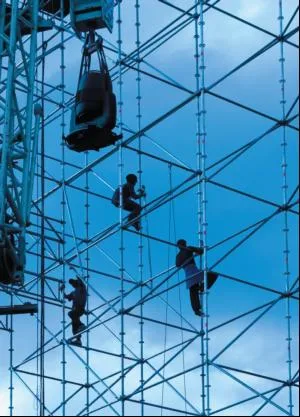
Last year, according to the HSE, more than 4000 employees
suffered major injuries after falling from height. In this
article Gary Fallaize,MD of RRC Training, explains how
companies can reduce problems in this critical area
While it’s true that certain sectors are
more vulnerable to height-related
accidents than others, no sector
can afford to be complacent. For instance, a
cladding firm was recently fined after an
employee fell through an open skylight and a
plant hire company was fined £200,000 when
an employee fell 5m to his death. There are
some simple steps companies can take to
minimise the risk:
Avoid work at height where
you can by using customised
equipment or where possible
taking the item down and
working on it at ground level.
Use work equipment or
other measures to prevent
falls where working at
height cannot be avoided.
This might include using
scissor lifts and scaffolds
rather ladders, or
something as simple as a
long-handled squeegee
when cleaning windows.
Where you cannot eliminate
the risk of a fall, use work equipment or
other measures to minimise the distance and
consequences of a fall should one occur.
This includes thinking about nets and
airbags to protect your workforce.
Practical considerations
There are also some practical rules which
should be followed. For instance:
When deciding on the equipment,
consider what the job entails, the duration
and location. Remember, ladders should only
be used for light work, as a means of access, a
work platform should be considered as one
of the most stable ways of working at height.
Consider the risk of falling objects.
Equipment such as electric drills can be
easily dropped, but also the little objects –
nails, screws or even rubble can cause
significant injury when falling from a height.
Again, planning and design is indispensable.
Platforms should be constructed so that
objects cannot fall, and tools such as drill
should be attached to safety lines.
Roof work accounts for the majority of
deaths and serious injuries. Roof workers
need the appropriate training as they must be
able to recognise hazards quickly, understand
the appropriate work systems and have the
competence to implement them. Risk
assessment should be carried out on all roof
work before commencement, and secure
entry and exit from a roof must be assured.
Creating the mindset
However, just as important as these practical
steps, is the ethos an organisation instills
among all those working on its site. This can
have a huge impact on accident levels. For
instance,Holcim Group employs 85,000
people worldwide and is a global supplier of
cement, aggregates (gravel and sand), concrete
and construction-related services. In 2006, it
started a project to improve the safety records
of the company’s Eastern European plants.
A total of 36 key employees – safety
officers or coordinators from each of the
territories – undertook the NEBOSH
International Certificate, joined by colleagues
from Russia and Azerbaijan. Training was
based on-site and organised entirely by RRC.
Sessions included lots of ‘real life’ situations
that Holcim staff encounter every day, rather
than theoretical scenarios. The course also
addressed the issues most relevant to Holcim
plants – including working at heights.
This training induced a real culture shift;
reporting levels improved and more
personnel identified hazardous situations.
Most impressively, there has been a 20%
reduction in injuries each year.
Nimble skills
Changing work patterns is another source of
height-related accidents. In tough times, in a
bid to keep headcount down but operational
flexibility up, staff are often assigned to new
roles. If their health and safety training does
not keep pace, accidents can happen. In these
cases quick, focused training is what’s required.
For instance, Ian McClymont a selfemployed
health and safety security manager
in the oil and gas construction industry in
West Africa, enrolled on our short working at
heights online course to familiarise himself
with all new regulations as he was about to
work on a pipeline that would involve
working at heights. The course quickly
helped him cover everything, from tips to
legislation through to day-to-day know-how.
When it comes to a high risk area such as
working at heights, the knowledge required
is not complex but it is essential. Training
has the potential to slash accident levels, keep
companies nimble and their staff both
flexible and safe. Companies who overlook it
– not only risk the health and well being of
their workers – they risk missing out on a
huge commercial trick.
IPE Newsletter
IPE publishes a weekly eNewsletter, delivering a carefully chosen selection of the latest stories straight to your inbox.
Subscribe here