

Filtering out the downtime
Shaun Skilton, product sales manager for the HFDE
Condition Monitoring Business Unit of Parker Hannifin,
highlights the importance of effective hydraulic oil filtration
and condition monitoring in industrial settings
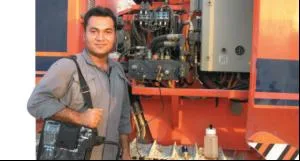
Shaun Skilton, product sales manager for the HFDE
Condition Monitoring Business Unit of Parker Hannifin,
highlights the importance of effective hydraulic oil filtration
and condition monitoring in industrial settings
Maintenance and its associated
downtime can represent a
significant cost to manufacturing
and engineering companies. In particular,
the management of large, yet critical
machinery, such as hydraulic systems – both
static and mobile – can be time consuming
and labour intensive, putting a significant
drain on capital and adding to life cycle costs.
In many instances, regular maintenance of
hydraulic systems is overlooked, partly because
such systems tend to be difficult to access,
and partly because some plant engineers
mistakenly take the view that the robust nature
of this technology means that it requires only
minimal attention. The quality of hydraulic oil
is rarely monitored effectively, with occasional
oil changes being seen as the easiest, but not
necessarily the cheapest, solution.
Many hydraulic devices are typically
exposed to contamination and/or climatic
extremes, including abrasive particulates,
moisture and humidity. The danger here is
that however robust a hydraulic valve,
cylinder or accumulator, it will still rely on
external seals, which can degrade in such
conditions, allowing contamination to enter
the hydraulic fluid and lubrication to be lost.
Contamination can also come from internal
sources, such as the wear of moving parts,
causing metallic particles to enter the oil.
Eventually this contamination means that
the oil will lose its lubricating properties,
leading to even more wear.
A reactive approach to maintenance
means that the use of hydraulic oils can
absorb considerable resources, particularly
with the increasing price of this material and
the costs associated with its disposal.
The monitoring of hydraulic oil condition
and early identification of contamination is
vital to prevent damage to seals, pumps,
cylinders, valves and other components,
which can degrade performance and
eventually cause catastrophic failures. An
efficient way to tackle this kind of predictive
maintenance strategy is to use a combination
of the latest condition monitoring technologies
and a practical approach to filter
replacement. Depending on the needs of the
application there are both low and high end
technology systems available. In each case,
much of the equipment is automated and
enables contamination levels to be accurately
detected and measured easily at point of use.
Modern devices are relatively low cost and
can eliminate particulates at levels far lower
than was previously possible.
For applications requiring something
relatively straightforward and simple to use, the
latest handheld instruments provide reference
correlation and repeatable results, detecting
and measuring the dielectric constant of a
small sample of oil to highlight changes in oil
condition caused by the presence of water,
particulate contamination, metallic content
or oxidation. Parker’s Oilcheck portable oil
indicator, for example, is small, lightweight
and battery powered. The most powerful
version has internal memory capacity to store
current calibration data and eliminate the
need to recalibrate for each test sample.
Readings are displayed both as a numeric
value to show positive or negative increases
in dielectric and on a simple to read,
circulate green/amber/red efficiency scale.
When used together, these displays allow
even gradual changes in oil quality to be
recorded and, in samples where contamination
has reached a critical level, for a problem to
be identified immediately.
Similarly, online particle detectors, such as
Parker’s icount series, use laser-based
technologies for ultra-high precision particle
detection. Once installed, these devices
continuously monitor the cleanliness of the
hydraulic oil, providing warnings of low,
medium or high contamination levels
through simple on-board LED indicators or
via links to remote control systems.
Although these condition monitoring
technologies can help engineers maximise
the performance and service life of
machinery, to be truly effective they need to
be used in conjunction with efficient
hydraulic filtration systems. The latest filter
technology can remove exceptionally low
levels of particulate and moisture
contamination, while maintaining high flow
rates. Such devices can prevent problems
occurring by ensuring contaminants are
removed before they can cause damage.
Filter elements require replacement at the
intervals recommended by the manufacturer,
regardless of their performance capabilities.
In some applications, with very high levels of
contamination it may be appropriate to
replace filters more frequently than normal,
until the source of contamination has been
identified and removed.
Sophisticated condition monitoring and
filtration technologies, and proactive
maintenance strategies, means servicing no
longer needs to be something that eats away
at time and profit.Maintenance can now be
viewed as something that can cut costs and
optimise the performance of critical
equipment, which translates to significant
benefits in productivity and profitability.
IPE Newsletter
IPE publishes a weekly eNewsletter, delivering a carefully chosen selection of the latest stories straight to your inbox.
Subscribe here