

Fire safety:Role of Responsible Person
Fire in commercial properties has the potential to be
catastrophic.Here, Graham Simons, technical manager of
the Fire Industry Association outlines the responsibilities of
the designated Responsible Person in ensuring the
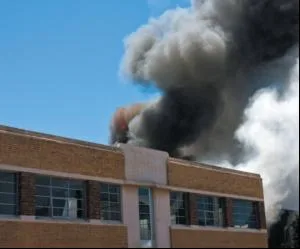
Fire in commercial properties has the potential to be
catastrophic.Here, Graham Simons, technical manager of
the Fire Industry Association outlines the responsibilities of
the designated Responsible Person in ensuring the safety of
those in the premises
Besides the human risk, businesses
suffer millions of pounds of costs
from property damage, fines,
compensation, and insurance premiums;
many are unable to recover.
In the UK, fire safety legislation has been
implemented through regional regimes and
different terms are used for the person with
duties for fire safety: In England and Wales,
the Regulatory Reform (Fire Safety) Order
refers to the ‘Responsible Person’; in Scotland
the Fire (Scotland) Act refers to the ‘Duty
Holder’; and in Northern Ireland the Fire &
Rescue Service (NI) Order and subsequent
Fire Safety (NI) Regulations refer to the
‘Appropriate Person’.
Despite these different titles, the duties are
essentially to ensure the safety of the people
in the premises. In this article I will refer to
the ‘Responsible Person’ for simplicity.
Fire law emphasises fire prevention and
reducing risk which is the duty of the
‘Responsible Person’. This is typically the
employer but can be anyone with some
control over premises. If a building has more
than one ‘Responsible Person’ they must
work together to co-operate, co-ordinate and
share information to comply with
regulations; reduce the likelihood of fire and
ensure people can safely escape during a fire.
Regulations apply to non-domestic premises
and in England and Wales, include
communal areas (eg hallways) of blocks of
flats or converted houses. However, it doesn’t
apply inside the individual private flat or house.
Duties of the Responsible Person
The ‘Responsible Person’ must take steps to
identify and reduce fire risk and ensure
people can safely escape. They must manage:
Fire risk assessments identifying hazards
and risks
General fire precautions
Application of principles of fire prevention
Fire safety policy and suitable fire
procedures
Those particularly at risk (disabled people,
those working with hazardous material
and so on)
Warning of fire in a building
Suitable means of escape including signs,
notices and emergency lighting
Fire extinguishers
Fire doors and compartments
Maintenance of fire equipment
Staff capabilities and training, fire drills
and evacuations
The ‘Responsible Person’ may appoint
others to undertake these duties however
they remain legally responsible. To show due
diligence, it is vital to ensure that all such
people are suitably trained, qualified and
experienced. Services should be provided by
professional and third party approved
companies.
Fire Risk Assessment
Fire risk assessment is fundamental to all
legislation and there are five key steps:
Identify fire hazards – including sources of
ignition, fuel and oxygen the components
of fire
Identify people at risk – people using the
premises and any people especially at risk
Evaluate, remove, reduce the risk and
protect people
Record, plan, inform, instruct and train –
record major findings and actions taken
Review the fire risk-assessment regularly
and change where necessary
Protective measures
The risk assessment should identify the
range of protective measures appropriate to
the premises and its use. The following
should need consideration:
Structural and passive fire protection
Fire detection and warning systems
Means of escape, emergency escape
lighting, signs and notices
Fire fighting equipment including
portable or fixed extinguishing systems
Recording, planning, informing,
instructing and training
Structural and passive fire protection
describe parts of a building providing
inherent fire safety and protection through
structural stability, fire separation,
compartmentation and a safe means of
escape.
The fire detection and alarm system will
alert people to a fire allowing them to escape
before they become trapped. Installers of
these systems should be third party certified
to either SP203 or LPS1014 to prove their
competence.
There must also be an adequate means of
escape with appropriate signage and lighting
for people to quickly and safely escape
avoiding the fire.
Some buildings will require fire fighting
equipment such as portable fire
extinguishers allowing people to tackle a
small fire. Extinguishers should be installed,
commissioned and maintained by a
SP101/ST104 certified company.
Other specialised fire fighting equipment
may also be required such as gas or
sprinkler extinguishing systems. Installers of
gas extinguishing systems should be
certified to LPS1204 while sprinkler system
installation companies should be certified
to LPS1048.
Enforcement of Fire Safety Law
An enforcing authority, usually the Fire and
Rescue Service, may apply alteration,
enforcement or prohibition notices if they
are not satisfied with the safety measures.
These will advise of any safety improvements
required and may even close the building
until sufficient measures are in place.
Penalties for breaches of fire safety
legislation can include heavy fines or
imprisonment of the ‘Responsible Person’.
The size of penalty is not affected by the size
of the company; it is based on the severity of
breach.
The FIA has produced a Best Practice
Guide to help the Responsible Person get to
grips with their fire safety duties. It is free to
download and available in the Responsible
Persons area and in Resources and FIA
Publications. Go to www.fia.uk.com.
IPE Newsletter
IPE publishes a weekly eNewsletter, delivering a carefully chosen selection of the latest stories straight to your inbox.
Subscribe here