

Go with the flow for measurement
A basic understanding of flow calculations and estimates
makes sizing valves a much simpler process, as John Baxter,
of Swagelok explains
Valve size often is described by the
nominal size of the end connections
but a m
A basic understanding of flow calculations and estimates
makes sizing valves a much simpler process, as John Baxter,
of Swagelok explains
Valve size often is described by the
nominal size of the end connections
but a more important measure is the
flow that the valve can provide. Using the
principles of flow calculations, some basic
formulas, and the effects of specific gravity
and temperature, flow can be estimated well
enough to easily select a valve size.
Flow Calculation Principles
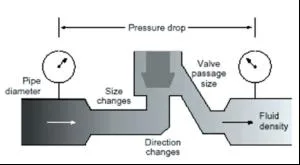
We need to know only the size and shape of
the orifice, the diameter of the pipe, and the
fluid density.We can then calculate the flow
rate for any value of pressure drop across the
orifice (the difference between inlet and
outlet pressures). (Fig. 1)
We also need to know the pressure drop
and the fluid density as well as all the valve
passage dimensions and all the changes in
size and direction of flow through the valve.
However, rather than doing complex
calculations, we use the valve flow
coefficient, which combines the effects of all
the flow restrictions in the valve into a single
number (Fig. 2).
Valve manufacturers determine the valve
flow coefficient by testing the valve with
water at several flow rates, using a standard
test method developed by the Instrument
Society of America for control valves and
now used widely for all valves.
Flow tests are done in a straight piping
system of the same size as the valve, so that
the effects of fittings and piping size changes
are not included.
Liquid Flow
Because liquids are incompressible fluids,
their flow rate depends only on the
difference between the inlet and outlet
pressures (?p pressure drop). The flow is the
same whether the system pressure is low or
high, so long as the difference between the
inlet and outlet pressures is the same.
Gas Flow
Gas flow calculations are slightly more
complex because gases are compressible
fluids whose density changes with pressure.
In addition, there are two conditions that
must be considered—low-pressure drop flow
and high-pressure drop flow.
When outlet pressure (p2) is less than half
of inlet pressure (p1)—high pressure drop—
any further decrease in outlet pressure does
not increase the flow because the gas has
reached sonic velocity at the orifice, and it
cannot break that ‘sound barrier’.
The equation for high-pressure drop flow
is simpler because it depends only on inlet
pressure and temperature, valve flow
coefficient, and specific gravity of the gas.
Effects of Specific Gravity
The flow equations include the variables
liquid specific gravity (Gf) and gas specific
gravity (Gg), which are the density of the
fluid compared to the density of water (for
liquids) or air (for gases).
However, specific gravity is not accounted
for in the graphs, so a correction factor must
be applied, which includes the square root of
G. Taking the square root reduces the effect
and brings the value much closer to that of
water or air, 1.0.
The effect of specific gravity on gases is
similar. Only gases with very low or very
high specific gravity change the flow by more
than 10% from that of air.
Effects of Temperature
Temperature usually is ignored in liquid flow
calculations because its effect is too small.
Temperature has a greater effect on gas flow
calculations, because gas volume expands
with higher temperature and contracts with
lower temperature. But similar to specific
gravity, temperature affects flow by only a
square-root factor. The plus-or-minus 10
percent range covers the usual operating
temperatures of most common applications.
Cited References
1. ISA S75.01, Flow Equations for Sizing
Control Valves, Standards and
Recommended Practices for Instrumentation
and Control, 10th ed., Vol. 2, 1989.
2. ISA S75.02, Control Valve Capacity Test
Procedure, Standards and Recommended
Practices for Instrumentation and Control,
10th ed., Vol. 2, 1989.
IPE Newsletter
IPE publishes a weekly eNewsletter, delivering a carefully chosen selection of the latest stories straight to your inbox.
Subscribe here