

Guide offers sound advice
An eight-point guide available from Cirrus Research offers
advice on how to choose appropriate noise measurement
tools and outlines some of the issues that need to be
considered – even after equipment has been purchased
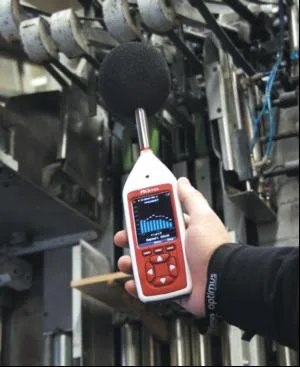
An eight-point guide available from Cirrus Research offers
advice on how to choose appropriate noise measurement
tools and outlines some of the issues that need to be
considered – even after equipment has been purchased
According to HSE statistics about 1.7
million workers are thought to be
exposed to noise above levels
considered safe. It is estimated that around
100,000 people have suffered hearing
damage because of their work with between
21 and 36% of these in engineering
occupations.*
Employers are expected to measure the
level of noise in the workplace so that
appropriate preventative action or protective
equipment can be introduced. Noise
measurement equipment is needed to carry
out this activity and with so many choices
available, and with prices ranging from £20
to £5000, deciding which one to buy can be
confusing – and expensive if the wrong
choice is made.
To assist with the selection process, Cirrus
Research has put together an eight-point plan:
Step 1 – Do the measurement functions
comply with Standards, Regulations or
Guidelines?
The Control of Noise at Work Regulations
2005 requires the following measurements
for compliance: The equivalent continuous
A-weighted sound pressure level (LAeq); the
maximum C-weighted peak sound pressure
level (LCPeak). It is important to have the
right sound measurement equipment for the
right situation. There are many situations
where using a handheld sound level meter is
not possible for both practical and safety
reasons, such as employees with complex
working patterns. A noise dosemeter offers a
solution as it can be worn for the entire shift
continually measuring the noise levels and
no further calculations will be required.
Step 2 – Accessories included?
Cirrus Research believes is advisable to buy a
sound level meter or noise dosemeter as a
complete kit. In general the kit will contain
the instrument, a suitable acoustic calibrator,
a windshield and a protective carrying case.
All noise measurement standards state that
an instrument must be calibrated before and
after each use and without an acoustic
calibrator, this cannot be done and therefore
any measurements made could be
inaccurate.
Step 3 – Recalibration and servicing
Noise measurement instruments are
precision tools, and the level of accuracy
required from them is high. Reputable
manufacturers spend time and effort
ensuring their instruments meet these
standards and it is important to keep the
equipment at the same level of accuracy as
when it was purchased. An instrument from
a trusted manufacturer and meeting the
latest standards should come with a
calibration certificate; when recalibrated its
performance should be checked against the
original specifications and standards.
Step 4 – Meeting specifications?
The latest sound level meter standard gives
two levels of accuracy, Class1 and Class2.
The Control of Noise at Work Regulations
2005 states that with regard to sound level
meters: ‘Your sound level meter should meet
at least Class 2 of BS EN 61672 – 1:2003’.
Personal noise dosemeters have their own
standard – BS EN 61252:1997.
Step 5 – Clear instructions
The level of training and experience required
to operate complex sound level meters can
often get in the way of making good quality
noise measurements. However, a simple
instrument that may require less training to
operate, might not give sufficiently accurate
measurement. An expensive instrument may
provide the data required, but the training
required could be expensive. Therefore, it is
recommended to choose an instrument that
meets your requirements while keeping it as
simple as possible and the cost realistic.
Step 6 – Simple to use?
Ensure the product you buy is user-friendly.
Ideally you need a product that enables you
to see all relevant, important information in
one place quickly, making it easier for you to
report on your measurements. At the very
least ‘on’ and ‘off ‘ buttons should be obvious
– on some equipment, even these
fundamentals are unclear.
Step 7 – Make sure equipment is
Futureproof
Find out how your investment will be
supported. A reputable manufacturer should:
Regularly conduct research into noise
measurement regulations and requirements
to ensure they are kept up-to-date with
changing needs; have an established R&D
team that ensures your equipment contains
the latest functionality; offer free software
updates; provide upgrades so you can easily
change the use of your equipment without
having to invest in new hardware.
Step 8 – Supplied with software?
Not all noise measurement equipment comes
with reporting software as standard. Putting
together a report using your findings can be
time consuming so it is advisable to ensure
that the equipment is supplied with full
reporting software for free as some providers
charge a license fee and this can prove
expensive.
*www.hse.gov.uk/pubns/eis26.pdf
IPE Newsletter
IPE publishes a weekly eNewsletter, delivering a carefully chosen selection of the latest stories straight to your inbox.
Subscribe here