

Helping drive down costs
With businesses looking to cut their energy bills and reduce
their carbon footprint, Stephen Takhar of Vacon UK believes
AC variable speed drives are one of the options to consider
The UK Government is committed to
re
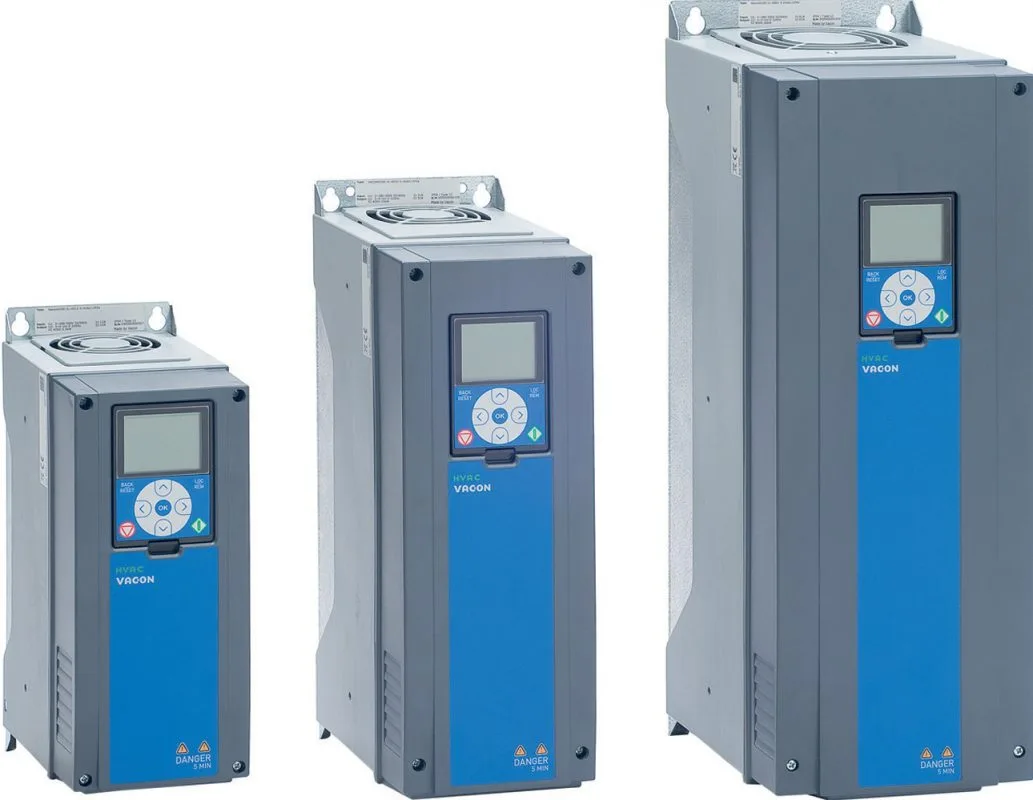
With businesses looking to cut their energy bills and reduce
their carbon footprint, Stephen Takhar of Vacon UK believes
AC variable speed drives are one of the options to consider
The UK Government is committed to
reducing the country’s greenhouse
gas emissions by 80%, compared
with the 1990 baseline, by the year 2050.
This means that businesses are going to be
squeezed as never before by legislation
designed to force them to reduce energy
usage. In fact, the pressures are already
starting.
An example is the CRC Energy Efficiency
Scheme, which affects around 20,000 large
public and private organisations who will
have to buy allowances for every tonne of
CO2 they produce. The more energy they
use, the more they’ll have to spend on
allowances. Similar pressures will soon be
applied to every business, large or small. So
what’s to be done? How can organisations cut
energy use?
There are many
possibilities, but one
option is the installation
of AC variable speed
drives. There are still a
lot of organisations that
have yet to go down this
road. Let’s see what
they’re missing.
Particularly attractive
savings can be made in
HVAC plant, which
invariably incorporates
motors driving pumps
and fans. In the past,
these motors were equipped
with simple fixed speed starters, and
diverters or throttling were used to regulate
flow. Running the motors at full speed all the
time is, however, bad news, as plant is
designed on a worst-case basis, and the
motors are sized for the coldest and hottest
days of the year. At all other times, they’re
doing far more work than necessary.
The logical solution is to rip out all the
single speed starters, fit modern AC variable
speed drives and regulate the speed of the
motors so that it matches the actual demand.
It’s easy to see that this will save energy, but
just how much energy might be a surprise.
The energy used by a fan or a centrifugal
pump varies as the cube of its speed. When
it’s running at half speed, therefore, it uses
0.5 x 0.5 x 0.5 = 0.125 times as much energy
as it does at full speed. In other words,
cutting the speed by 50% reduces energy use
by 87.5%.
So why aren’t AC drives being fitted
everywhere? There’s no simple
answer. Some organisations may
still not be aware of the savings
potential, although it’s hardly a
secret. Probably the biggest issue,
however,
is that
organisations are concerned about the cost
and disruption associated with installing new
drives.
In reality, neither of these concerns is
valid. Variable speed drives are not expensive
and installation is almost always
straightforward. Many drives also qualify for
the Enhanced Capital Allowances (ECA)
scheme, which means that 100% of their cost
can be offset against tax in the year in which
they are installed. But the real clincher must
surely be the ongoing savings on energy
costs – in most cases, the cost of fitting AC
variable speed drives is recovered in two
years or less.
Now let’s consider disruption. Modern
drives are small and easy to accommodate,
and they are available in enclosed versions
that can, for example, be mounted directly
on a wall without the need for further
protection. There may be a need to fit other
devices such as flow sensors, but this is no
problem for an experienced drive installer.
The arguments in favour of replacing fixed
speed starters with AC variable speed drives
are convincing, but remember that not all
drives are created equal and it’s important to
choose the right drives for the job. Invariably,
these will be types specifically designed for
HVAC applications – general-purpose
industrial types will work, but they are likely
to need costly add-ons to provide
functionality already included in HVACspecific
drives.
Look for functions like real-time clocks to
shut the system down automatically outside
normal occupancy hours, PID controllers
that allow the motor speed to be controlled
directly from flow or pressure sensors, and a
sleep option that completely stops the motor
when demand falls to zero.
Efficient HVAC drives also
have good EMC
performance so that
even if they are used
in large numbers on
a site they do not
adversely affect the
supply quality.
Finally, they use
components chosen
to provide long
reliable working
lives. In particular,
the latest drives use
film capacitors rather
than electrolytic
types. Film
capacitors not only
have long lives, they
are more
environmentally
friendly as they have
no electrolyte to
create a pollution
hazard when they are ultimately discarded.
Fitting AC variable speed drives to HVAC
plants really is an energy- and cost-saving
opportunity too good to miss. The drives are
inexpensive, reliable and easy to install with
a minimum of disruption. But remember that
the best results will be obtained by choosing
dedicated drives from a supplier with a
proven track record in the HVAC sector.
IPE Newsletter
IPE publishes a weekly eNewsletter, delivering a carefully chosen selection of the latest stories straight to your inbox.
Subscribe here