

In the picture before you buy
Like most things in life, the best choice of infrared camera
comes as a result of thorough homework. Here,Andy Baker
UK & Ireland sales manager of FLIR Systems offers some tips
for those considering investing in such a cam
Like most things in life, the best choice of infrared camera
comes as a result of thorough homework. Here,Andy Baker
UK & Ireland sales manager of FLIR Systems offers some tips
for those considering investing in such a camera
Infrared technology is now both accessible
and affordable and the camera market is
extensive. However along with this
wealth of choice are several potential pitfalls
so what should you be looking out for?
Accurate, repeatable results
You should always make sure that the
infrared camera meets the minimum
industry standard of ±2% or 2.2°C,
whichever is greater. If the spec of the model
you are considering can’t perform at this
level, look for another camera. Why is this
important? Quite simply,
accurate measurement equals
efficient fault finding.
When it comes to
repeatability, one of the key
requirements is to tune your
camera to the application by
inputting emissivity or
reflected temperature values.
Be certain that your chosen
model will allow you to
perform this important
task.
Image quality
You can judge the quality of
images from an infrared
camera in the same way as you do those
from a digital camera; basically the more
pixels, the better the resolution and the
sharper the infrared image.
There is a caveat here however. If an
infrared camera boasts 640 x 480 pixels
resolution check that this refers to detector
resolution and not just the resolution of the
LCD display. The display resolution is
irrelevant if the detector is inferior.
Chargeable battery
You don’t want your infrared camera to ‘die’
in the field – it wastes time, reduces
inspection efficiency and at worst exposes
you and your colleagues to the risk of an
undetected fault. So always buy a model that
has a field-replaceable battery and make sure
the kit comes with a charger (preferably an
in-car type) and the option of a spare
battery. Choosing lithium ion technology is
also the best bet as it provides longer battery
life.
JPEG output
Choose an infrared camera that is capable
of outputting an image in standard JPEG
format complete with embedded
measurement data. Not only does this keep
all the image data together, it makes it easy
to email the information to a colleague or
customer or import it into any Microsoft
Word document such as a report.
Comfort and ease of use
If you plan to use your camera frequently
or for extended period, choose a
lightweight, ergonomic model that won’t
cause you back or arm strain. The
positioning of buttons and keypad should
also be considered with regard to ease of
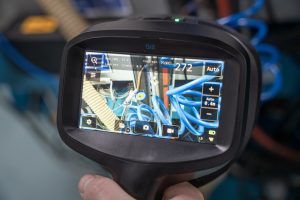
use. Some cameras have features such as a
touch screen keypad or sketch-with-stylus
and although they may add a little to the
cost they can make a huge practical
difference.
Some infrared cameras require multiple
steps or complex menu navigation to do
simple tasks. Always take the proposed
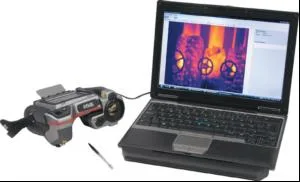
camera for a ‘test drive’. Take an image,
download it to your PC and create a basic
report.
Upgrade path
Most cameras come with free software to
help you analyse your images and create
reports. Many users soon find however their
needs become more sophisticated in line
with their growing experience. So when you
buy a camera make sure there is an upgrade
path. Even ask for a demonstration of the
capability level above the one you are
considering.
Also look out for infrared cameras that
allow you to upgrade the firmware to
increase pixel counts and infrared resolution
as well as features and functionality. Find a
company with which you can grow.
Temperature range
This is basic but vital – be sure the
temperature range of your proposed camera
is compatible with the targets you will be
viewing.
Adequate fusion
There’s a lot of buzz about fusion
capabilities with infrared cameras but the
advice is to be certain that what you choose
is advanced and flexible enough to meet
your needs. There’s no value in choosing
simple picture-in-picture functionality
when what you really want to do is
customise your fusion to the exact target.
… and finally
Last but by no means least buy your
camera from a manufacturer with strong
post-sales technical support and certified
training. Go for one whose training arm is
ISO 9001 registered and has a good
number of ASNT Level II and BINDT
Category 3 certified thermographers on its
staff.
Related posts

IPE Newsletter
IPE publishes a weekly eNewsletter, delivering a carefully chosen selection of the latest stories straight to your inbox.
Subscribe here