

Incremental versus absolute sensors
Many engineers still specify incremental position sensors because they think absolute versions are too costly. Here, Mark Howard of Zettlex looks at the relative merits of incremental versus absolute approache
Many engineers still specify incremental position sensors because they think absolute versions are too costly. Here, Mark Howard of Zettlex looks at the relative merits of incremental versus absolute approaches
If you’ve never really understood the difference between incremental and absolute measurement, don’t worry – you’re not alone. Plenty of engineers have never really got to grips with the terminology and some sensor manufacturers have confused matters by claiming absolute measurement when what they really offer is incremental.
We will use the term ‘sensor’ to cover encoders, transducers and detectors. The distinguishing feature of an incremental position sensor is that it reports an incremental change in position. In other words, when an incremental sensor is powered up, it does not report its position until it is provided with a reference point from which it can measure.
An absolute sensor unambiguously reports its position within a scale or range. In other words, when an absolute sensor is powered up it will report its position without the need for any reference information. ‘What happens on power up?’ is a good acid test to differentiate the two types of sensor. If the sensor has to go through some form of calibration step – it’s incremental; if it doesn’t – it’s absolute.
Some sensor manufacturers claim absolute measurement performance because a battery stores position information from the incremental sensor when power is lost. OK, but what happens when the battery runs out? Some manufacturers claim absolute measurement performance when an incremental sensor needs to move only a small amount at power up to gain the reference information. These are incremental sensors, priced as absolute sensors.
Potentiometers are still the most common form of position sensor, but in the past 25 years use of non-contact sensors has grown significantly. This trend is due to the problems associated with potentiometer wear and reliability – especially in harsh environments (notably vibration) or extended life-times.
Potentiometers are almost always absolute but a common form of non-contact sensor is the optical encoder. These devices work by shining a light through or onto an optical grating and calculating position from the intensity of the returned light.Most optical devices are incremental. Typically, the position information is delivered using a series of pulses – usually in phase quadrature, so that direction of travel can be determined. These are usually referred to as A/B pulses. A separate pulse train, typically referred to as the Z reference, provides one pulse per revolution to act as a reference mark.
The absolute optical device is similar but uses a different kind of scale, whereby absolute position is determined at power up – without the need for a reference mark.
Typically, these sensors have a digital output and their resolution is defined by the number of bits in the output. A 10-bit device will offer 1024 counts; an 11-bit device will offer 2048 counts and so on.
About three times as many incremental sensors are sold as absolute sensors. One reason for this is an incremental sensor is usually cheaper than an absolute sensor of otherwise comparable performance.However, nowadays absolute sensors are not as expensive as many might believe. A change to (non-contact) absolute position measurement can offer better performance, better accuracy and lower overall costs. This is because there can be practical problems with the incremental sensor approach. For example, every time power is lost the system must perform a calibration step, which slows system performance and may have safety implications if power is lost suddenly.
Position is calculated by counting from a reference mark. In some instances – notably voltage supply variation or high speed position changes – count can be lost. This has a potentially catastrophic effect on operation which, if unchecked, can lead to prolonged out-of-synch operation.Most incremental sensors are optical and in order to provide high resolution readings, very fine features on the optical grating must be used – sometimes the features measure just a few microns across.While such fine features increase sensitivity, it means that they become more delicate and susceptible to foreign matter.
Moisture, grease or dirt can cause an optical device to stop working – or, worse still, produce incorrect readings.
The price differential between absolute and incremental sensors has reduced in recent years partly because of the greater use of absolute sensors but, more importantly, the introduction of new, absolute sensing techniques.While optical sensors remain the automatic choice for some engineers, new generation inductive devices now offer accurate, absolute position sensors that are unaffected by harsh environments.
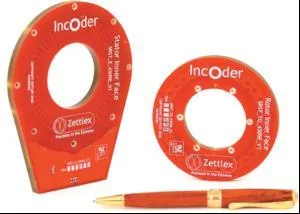
Rather than a grating and optical sensor, these inductive devices use printed, laminar windings. Their fundamental operating principles are similar to those of a transformer or resolver. The fundamental physics enables absolute, compact, lightweight, high resolution sensors, which are not dependent on optical features passing a light source. They are unaffected by foreign matter such as dirt or moisture, and their measurement performance is generally unaffected by offsets or generous mounting tolerances. This means they do not need precision housings or bearing assemblies and can be simply fixed to the host system’s mechanical parts. This enables simplification, size and weight reduction of the surrounding mechanical parts through eradication of bearings, shafts, couplings, seals. The latest inductive devices can be arranged with a generously sized through bore to allow the passage of the host equipment’s shaft, cables or slip-rings. This means absolute measurement performance can be offered at roughly the same price as a traditional incremental device.
IPE Newsletter
IPE publishes a weekly eNewsletter, delivering a carefully chosen selection of the latest stories straight to your inbox.
Subscribe here