


It’s energy first and foremost
Variable speed drives have been around for many years, but
they are still finding new uses across all sectors of industry.
Matt Handley, Mitsubishi Electric’s product manager for
Drives and Low Voltage, considers current
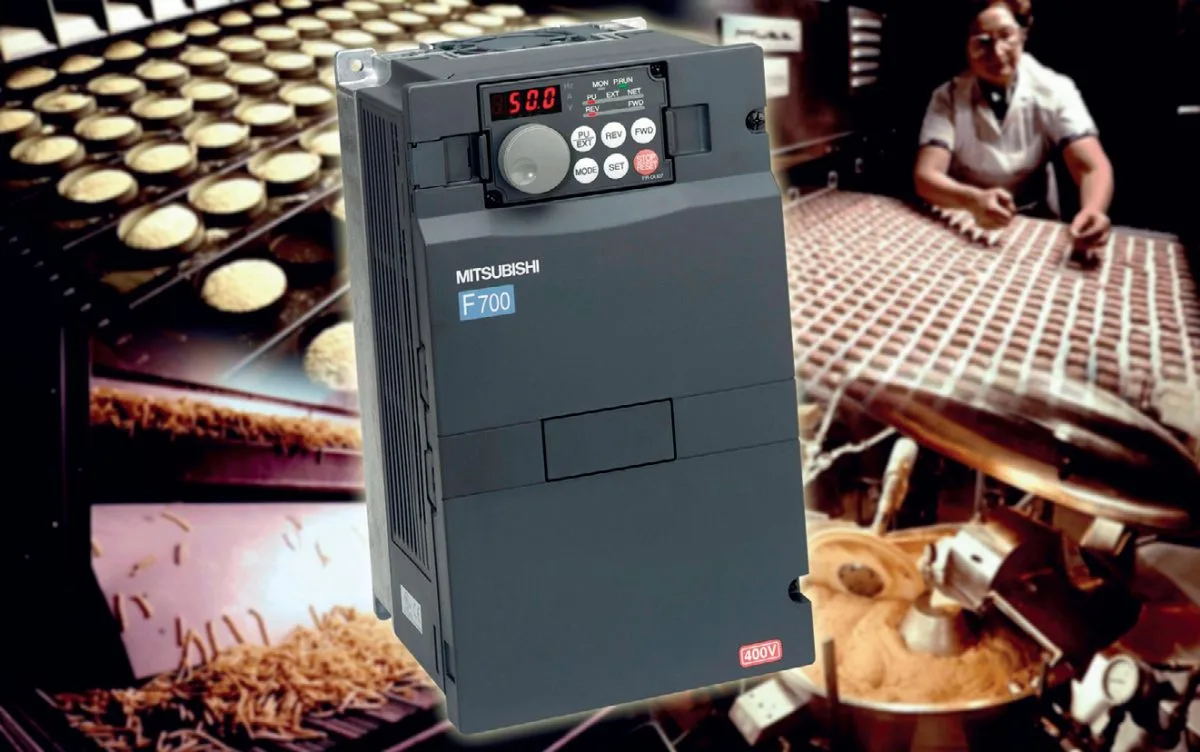
Variable speed drives have been around for many years, but
they are still finding new uses across all sectors of industry.
Matt Handley, Mitsubishi Electric’s product manager for
Drives and Low Voltage, considers current hot buttons
Today, the three key topics for drives
are energy, energy and energy! After
that you can list developing
standalone drives systems, networking drives
and servos, and integrating safety into drives
as almost as significant.
Several years ago governments woke up to
the fact that carbon emissions were getting
critical and set about encouraging energy users
to look for ways to cut their power demands.
The tool they are using for this is basically tax.
Details vary from country to country, but
organisations that reduce their consumption
stand to save significant amounts of money.
Drives are brilliant at saving energy. If you
reduce the speed of a motor, it is possible in
most pump and fan applications to save
energy proportional to either the square or
cube (depending on the application) of the
reduction. It may be that in a particular
application you never need full speed and
power, so a drive can trim output to a lower
optimum level. In other applications you
may need full speed, but not all of the time.
Sometimes half speed is appropriate, while at
other times quarter speed is adequate. You
can set a drive up to provide this sort of
variable output, either on a timer or as a
response to real-time sensor inputs.
In some applications there may be the
possibility of stopping the motor altogether
for significant periods. Savings soon add up.
Another way of energy saving that is
gaining popularity is using a drive to
regenerate power that would otherwise be
wasted. Most applications have deceleration
stages in their duty cycle – that is to say
kinetic energy is removed from the moving
load. Traditionally this is simply lost, perhaps
through braking resistors or a mechanical
brake. However a drive can capture this
energy and feed it back into the mains, often
leading to significant net energy savings.
Regeneration is also possible if a conveyor
runs downhill, if an air or water flow is
reduced, or if a load is lowered.
Something like 66% of all industrial
electricity generated is used to run motors
which equates to about 25% of total UK
consumption. A large percentage of these
motors where speed or load could be varied
are yet to be fitted with VSDs. So the potential
for drives to make a significant contribution
to carbon reduction is enormous.
Motors appear very efficient, but dig
deeper and several issues come to light.
Many are oversized for the job they are doing;
swapping them for a smaller one will provide
energy savings – and a drive can be used to
‘beef up’ output for those parts of the duty
cycle where extra power is needed. Induction
motors are the workhorses of industry, but in
many cases switching to permanent magnet
motors will pay handsome energy dividends,
and again a drive will optimise energy usage.
Discrete parts manufacturing, process
control, building management… Almost every
technical system you can name is becoming
more intelligent. Various parts of the system
communicate with one another to optimise
overall performance. This requires individual
devices – drives, PLCs, HMIs, and sensors –
to send and receive data and to act intelligently
on it. For instance, modern drives can receive
a temperature signal and adjust the speed of
a ventilation fan or water pump accordingly
using built-in PID controllers. Other drives
may work with counters or timers to control
parts production. A motion detector in a
building’s security system could work with a
drive to close a shutter, turn down air
conditioning, open a car park gate, and so on.
Modern drives offer ever greater levels of
motor shaft control and this is especially
important when they are used in motion
control applications. An example of this is
when they are networked together with servo
drives over specialist high speed fibre optic
networks such as SSCNet. The servos will
control the high precision axes in the system,
and they will communicate with the inverter
drives on the general axes to improve overall
system performance. It is worth noting that a
top-of-the-range drive can enhance an
industrial motor’s dynamic performance to
near servo capability, so is suitable for axes
where some extra precision is required.
The water industry and others often have
systems that are physically remote from one
another. Until recently, these were kept as
simple as possible. However, attitudes are
changing, driven both by a desire to reduce
energy consumption and by the need for
remote interrogation. Drives play a major
part in this, offering a series of ‘keep on
running’ functions, and drives designers are
developing systems that can run intelligently
but unattended for perhaps months at a time.
Changes to the machinery directive mean
machinery designers now have to design-in
more rigorous safety systems and carry out
more in depth risk assessments. Inverter drives
can be a key component in a machine, so the
move for drive manufacturers to embed
safety functionality into their drives has grown.
This functionality is equally important if the
machine is redesigned. Embedded safety
features means it is possible to cut down on
components and reduce machine build costs.
Related posts


IPE Newsletter
IPE publishes a weekly eNewsletter, delivering a carefully chosen selection of the latest stories straight to your inbox.
Subscribe here