

Lighting the way to energy savings
About 70% of commercial installations in the UK still use
inefficient fluorescent tubes, but with savings to be made by
retrofitting an efficient lighting scheme, there is no reason
not to make the switch.Dave Ellis, natio
About 70% of commercial installations in the UK still use
inefficient fluorescent tubes, but with savings to be made by
retrofitting an efficient lighting scheme, there is no reason
not to make the switch.Dave Ellis, national sales manager –
specification at Osram, outlines some of the options
An efficient lighting scheme tailored
toward the specific activity taking
place in an industrial workplace
improves quality, productivity and safety.
Today, solutions are available which create
the perfect lighting ambience while
minimising costs. This is due to the lower
energy consumption of these lamps and
their longer lifetime which leads to reduced
maintenance costs.
A crucial factor to consider in selecting the
lighting scheme for a building
is the task to be performed
within it. In a factory that
manufactures, assembles and
prepares goods, productive
lighting that meets certain
criteria should be installed.
Lamps should provide high
luminance and optimum
directional lighting to
improve productivity,
reduce error rates and cut
the risk of accidents. Also,
uniform illumination and
appropriate positioning of
luminaires prevents reflected
glare from the surfaces of
workstations and machinery which helps
avoid premature fatigue among workers.
The colour temperature of a lamp is as
important as its positioning. Lumilux
Skywhite lamps, for example, have a light
colour of 880 that offer high levels of
contrast for reduced eye fatigue and lower
error rates, particularly for employees on
shift work.
Special considerations need to be made in
certain environments. In factories where
food is packaged, fluorescent tubes such as
Osram’s Lumilux Split Control T8 are
suitable. These feature a plastic coating that
retains splinters if the lamp is broken. In
some cases it is also important to use special
explosion-proof luminaires. Luminaires with
enclosed housings and glass covers are easy
to clean, so can be used in environments
with high levels of dirt and contamination.
Ensuring the high quality of products is
key to the success of any manufacturer and
light plays a crucial role in identifying if
products are up to scratch. Lamps with high
luminance and optimum natural colour
rendering properties are essential for
illuminating quality assurance testing areas
so that faults and discrepancies can be
quickly and reliably detected.
Large luminaires with opaque covers and
dimmable T5 fluorescent lamps provide
glare-free illumination for surface
inspections. The inspection of rough and
structured surfaces calls for adequate shading
and requires a light that can be adjusted to
give light in different directions. This can be
achieved with innovative LED modules or
energy efficient halogen reflector lamps.
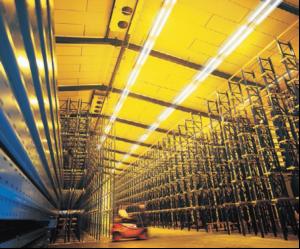
Warehouses with high ceilings are often
without natural daylight. For work to be
effective and efficient it must be possible to
identify the shapes and colours of various
products, packaging, labelling easily and
reliably. In addition, ceiling luminaires have
to meet strict anti-glare requirements and
people working in these areas often have to
look upwards.
Narrow-angle strip lighting solutions such
as T5 fluorescent lamps connected to
electronic control gear (ECG) are suitable for
illuminating shelving areas, particularly as
these lamps can handle on/off switching. For
heights of 5m or more, glare-free prismatic
reflector luminaires fitted with high output
compact fluorescent lamps or high-intensity
discharge lamps offer a solution.
In areas that are difficult to access, it is
advisable to install lamps that benefit from a
long lifetime as you will not have to change
the lamp very frequently and this leads to
reduced maintenance costs. Lamps such as
Osram’s Lumilux XXT and XT T8
fluorescent tubes have service lives of up to
75,000 and 42,000h respectively when
operated on ECG.
The criteria for good lighting conditions
in the industrial environment are defined in
various standards and directives. These
include adequate luminance, absence of
glare, good colour rendering, appropriate
light colour, and uniformity of light. In
addition, lamps used should be as efficient as
possible to reap savings for the user.With the
latest industrial lighting solutions, you can
meet the criteria for industrial lighting
schemes while benefitting from reduced
maintenance costs and efficient lighting
conditions which optimise employee
performance.
IPE Newsletter
IPE publishes a weekly eNewsletter, delivering a carefully chosen selection of the latest stories straight to your inbox.
Subscribe here