

Maintenance:It’s not just about lube
It’s probably a historical preoccupation with lubricants
keeping the wheels of industry turning that has been
reinforced in the media over the years, but to talk of
maintenance chemical and lubrication as interchangeable
It’s probably a historical preoccupation with lubricants
keeping the wheels of industry turning that has been
reinforced in the media over the years, but to talk of
maintenance chemical and lubrication as interchangeable
and inevitably linked terms does not show the complete
maintenance chemical situation.
The maintenance schedule involves many components,
each as important as each other to deliver reliable,
productive and efficient production.Whether it is
‘invisibles’ such as training, timely schedules, and backroom
activities like the engineering workshop; or physical
ones: tools, components, parts, and chemicals; each
combines with the others to deliver a service greater than
the sum of its parts.
Should one piece be missing, sub-standard, or
overlooked, then it is often the case that the trinity of
‘reliability, efficiency, productivity’ is compromised
resulting in increased maintenance frequency or
breakdown.
Primary focus
To say that lubrication is the primary focus of the
chemical constituent of a maintenance process is not
incorrect as often a squirt of grease or top-up of oil is all
that is required to complete the works order, but should
more extensive servicing be called for it will require some
component or part of production machinery to be taken
apart, inspected, and replaced in order to identify if it is
the cause (or likely future cause) of problems.
This is where the maintenance chemical options open
up revealing the true extent of the choice:
cleaners/degreasers, lubricants, anti-corrosion, metal
cutting, welding, wipes and more.
Cleaners and degreasers are designed as a critical first
stage of the servicing process, ensuring that all lubricant,
grime and dirt contamination is removed allowing the
clean surfaces to be inspected without the risk of dirt
obscuring faults, getting into close-tolerance gaps and
preventing recontamination during re-lubrication and
assembly. A maintenance schedule needs to start and
finish with cleaning to ensure a thorough job.
Lubricants and greases degrade with use and time, the
rate at which depends on a great number of variables.
Should re-lubrication now be carried out, contamination
and old lubricant will mix with the new resulting in
inefficient operation and, at worst, a light grinding paste
that quickly destroys components. It is good working
practice, therefore, to completely degrease and clean in
these situations to avoid decreased machine life,
unplanned down-time, and inefficient operation.
Compatibility issues
The technology behind cleaning chemicals is complex:
through the manipulation of chemical formulations
specific cleaning properties can be displayed: fast
evaporation, foaming action, grease removal, dry deposit
removal, material compatibility, and so on. Typically
solvent and citrus based cleaners may be better at
removing greases and heavy/light oils, with water based
products able to remove drier or staining materials.
Material compatibility must also be taken into account.
A poor quality cleaner or the wrong cleaner is
sometimes selected, whether it is due to perceived cost
savings or simply using the same cleaner as always, in
either case more product will be used as cleaning
efficiency is reduced, but the real cost is more easily seen
in lost time; waiting for the chemicals to remove the
grime.With lower quality/imported products, the active
ingredients may be present in reduced quantities than in
‘market leaders’, such as Ambersil.
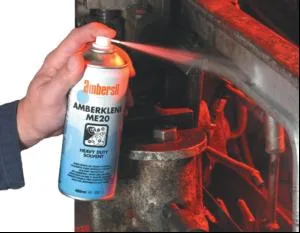
Ambersil offers a comprehensive range of industrial
cleaners and degreasers, backed-up by lubricants, anticorrosion,
metal cutting, welding, paints, and more. All
are available nationwide through key distribution
partners. The comprehensive MRO range gives engineers
and buyers a single source supply where cost savings may
be had without compromising on quality and top-line
performance.
Many products are specified to military, aerospace and
industrial standards including NSF food industry
registered products.
IPE Newsletter
IPE publishes a weekly eNewsletter, delivering a carefully chosen selection of the latest stories straight to your inbox.
Subscribe here