

Measure to manage
Energy efficiency is paramount in the minds of most
organisations.However, according to Loïc Moreau of LEM,
many have little idea of whether or not they are efficient, or
what the opportunities are for improvement
Ene
Energy efficiency is paramount in the minds of most
organisations.However, according to Loïc Moreau of LEM,
many have little idea of whether or not they are efficient, or
what the opportunities are for improvement
Energy use often represents a large
proportion of an organisation’s costs,
so any improvement in efficiency will
benefit both the bottom line and the
environment. Despite this fact, many
organisations spend a large amount of time
minimising equipment purchase costs, but
pay little or no attention to the running
costs. For equipment that consumes power
this is a big mistake! For example, 95% of the
costs of a motor may be the energy it
consumes, with maintenance accounting for
3% and the motor’s price accounting for
only 2% of its total lifetime costs.
Organisations need to understand where
and how energy is being used if they are to
identify opportunities for reducing energy
use. As Lord Kelvin implied more than 100
years ago: “If you can measure
it, you can manage it.”
Energy monitoring is a key
factor for compliance with a
range of regulations being
enacted throughout the EU.
Through legislation,
governments hope to
achieve CO2 emission
targets and to make
businesses more
competitive. In the UK the
carbon reduction
commitment requires large
organisations to monitor
energy use and report on
their equivalent carbon dioxide
emissions and building regulations require
new commercial buildings to record, by
function, at least 90% of their energy usage.
Because most organisations don’t have a
good picture of how and where they
consume energy, they need to start
measuring without delay. The benefits are
clear, so why is it not being used to its full
potential? A key reason is the association of
monitoring with conventional sub-meters,
associated with difficult, disruptive, and
expensive installation.
Wireless solutions
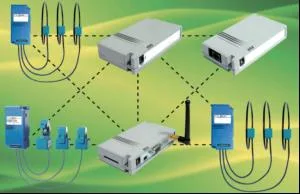
Modern wireless energy meters offer a
simple, low-cost and flexible approach that
allows organisations to acquire detailed
measurement data, providing facilities
managers with the information they need to
track and allocate energy costs to particular
activities, allowing them to identify where
energy is being wasted.
Measuring energy consumption can be
particularly useful in industrial applications
where it can be used, for example, to benchmark
one production cell against another.
Any major discrepancy indicates a need for
investigation, which may reveal problems
such as motors using too much energy due
to worn bearings, or equipment that is
operating inefficiently because it is in need of
lubrication or other maintenance.
Identifying such issues not only eliminates
energy wastage, it helps to prolong the life of
machines by highlighting potential problems
so they can be remedied before developing
into full scale failures.
Wireless communication is suitable for
installations in existing buildings, allowing
deployment with little or no disruption to
those using the premises. It also enables
measurement of energy use to be
implemented in, for example, historic
properties where installation of additional
cabling is not permitted and where
monitoring usage would previously have
been difficult or impossible.
The process of minimising energy
consumption is an iterative one, typically
following a cycle of plan-do-check-act (also
known as a Deming or Shewhart cycle). This
approach often means systems measuring
energy use need to be modified to allow for
more detailed investigation of potential
wastage, or to accommodate changes to the
internal layout of a building.Wireless
transducers can be moved around as needed,
with minimal disruption and very little cost.
New technologies mean that no
reconfiguration of equipment is required as
the transducers automatically recognise and
communicate with the nearest repeaters and
gateways. This also ensures exceptionally
reliable operation, as the system can
reconfigure the network to bypass
equipment that has failed. The latest devices
also offer an RF output power of 10mW,
providing a long range within the building,
even when transmitting through walls.
Unlike conventional sub-meters, modern
energy monitoring systems can provide
detailed information on parameters such as
active and reactive power, current, and
voltage in real time. Understanding shortterm
changes gives greater insight into the
way energy is used and helps organisations
reduce peaks in consumption, which are
often linked to higher tariffs.
Modern energy management solutions
give organisations the opportunity to
integrate their measurement of energy use by
monitoring other utilities such as gas and
water as well as environmental information
such as temperature and humidity. This
approach provides much richer
measurement data that can often make it
easier to identify problems. For example if a
heating system is operating on a warm
summer day, there is clearly a problem that
needs immediate investigation.
Modern wireless solutions, such as Wi-
LEM, offer straightforward, non-disruptive,
and inexpensive installation and operation as
well as the opportunity to monitor other
utilities and environmental conditions.With
so many benefits and none of the old
drawbacks, there is no excuse – organisations
should start measuring energy usage now.
IPE Newsletter
IPE publishes a weekly eNewsletter, delivering a carefully chosen selection of the latest stories straight to your inbox.
Subscribe here