

Measuring the ageing process
The days of estimated and approximate values will soon be
over as far as desiccant management in compressed air
processing is concerned, according to Horst Singer of Beko
Technologies.Here, he outlines a new test method th
The days of estimated and approximate values will soon be
over as far as desiccant management in compressed air
processing is concerned, according to Horst Singer of Beko
Technologies.Here, he outlines a new test method that will
soon be available for adsorption dryers
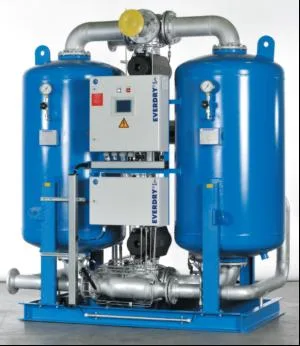
Continuously operating tin column
adsorption dryers function according
to the dynamic adsorption principle,
meaning that the compressed air to be dried
flows through a desiccant bed. During this
process, moisture is removed from the
compressed air. As the capacity of the
desiccant is limited, the compressed air flow
is redirected to the regenerated vessel prior
to full saturation. The adsorption vessels
have a changeover function to allow the
continuous supply of dried compressed air
to the points of consumption.
There is always one adsorption vessel
available for the drying process. The
adsorption vessel loaded with moisture will
be reactivated. The
activation period
(regeneration) is always
shorter than the loading
time of the service vessel.
Desiccant ageing
Compressed air always
consists of a mixture of
different gases and
contaminants. In
addition to water,
contaminations by
hydrocarbon
compounds, flue gases
from combustion
processes (such as CO2,
CO, NOx, SO2) or by solid
particles, such as dusts, can nearly always be
found. The substances which cannot be
removed through filtration accumulate on
the unsaturated boundary surfaces of the
desiccant and in this way reduce the
absorptive capacity of the desiccant for water
vapour and water aerosols. The depositions
are not completely dissolved during
regeneration. During desorption at higher
temperatures, these contaminations can even
lead to the cracking or polymerisation of
organic molecules. The permanent residues
affect the capacity, ie the service life of the
desiccants.
The reduction in the ability to adsorb
water starts at the inlet of the desiccant bed
where the loading is highest. The zone of the
adsorption vessel where the capacity
decreases will then ‘grow’ towards the outlet
port. Related to the quantitative properties of
the desiccant, this process leads to a loss of
efficiency of the adsorption dryer.
The outlet zones of each adsorption vessel
are decisive for the quality of the released
compressed air. This area is subject to
natural ageing which slowly takes place over
a period of many years of operation. The
rapidity of the ageing process is significantly
influenced by the number of regeneration
cycles, the quality and the temperature level
of the desorption air.
With a decreasing adsorption capacity, the
desired degree of dryness is no longer
achieved over the full adsorption cycle,
regardless of whether the decrease is a
consequence of a deterioration of the
quantitative or the qualitative properties of
the desiccant. An introduction of moisture
into the connected compressed air system
starts.This can lead to expensive breakdowns
either through production stoppage, rejected
goods or the re-working of defective
products. The consequence could be supply
shortages or even delayed delivery dates with
the inevitable contractual penalties.
To detect the loss of efficiency of a
desiccant at an early stage, BEKO
Technologies has developed a method where
reaction is replaced by pro-activity. Instead
of carrying out repair works, priority is given
to function maintaining preventive
measures.
Time for desiccant replacement
The introduction of moisture into the
compressed air system can be avoided by the
replacement of the desiccant in good time.
With regards to maintenance, there are
different service strategies, each with their
own advantages and disadvantages:
Repair after a breakdown
The dryer is used beyond its maximal
operating time. Subsequent to moisture
penetration at the outlet of the adsorption
bed, introduction of moisture into the
compressed air system starts. A dew point
measuring device would indicate the failure
and react with a fault message. However,
there may not be time for a preventive
measure to stop the failure. The plant will be
out of service until there is a new charge of
desiccant and a service technician is
available.
Servicing in accordance with predefined
maintenance intervals
The manufacturer of the adsorption dryer
defines the service life of the desiccant on the
basis of operating hours. They consider
neither the individual degree of use nor
plant contaminants. Beko believes that the
risk of malfunction will not be detected in
time. The replacement intervals are not
demand oriented but take place after a
defined period of time specified in the
operating instructions. Each time, 100% of
the desiccant is replaced, resulting in
maximum costs.
Condition-oriented servicing
The concept of condition orientation is
based upon the regular measurement of the
desiccant condition. The service life of the
desiccant is almost entirely used without
lowering the efficiency of the dryer.
For this, regular control of the desiccant
efficiency is imperative. The result of this
control could be that partial replacement of
the desiccant bed will suffice. Here, the
desiccant in the highly-loaded inlet zone is
replaced by the material from the outlet
zone. Subsequently, the adsorption vessels
are refilled with new material. The efficiency
of the adsorption dryer is re-established. In
this way, the amount of desiccant to be
replaced is limited.
The Q-test
For the so-called Q-test, liquid water is filled
into a glass vessel in which a desiccant
sample was placed beforehand. Reaction heat
forms as a result of the exothermal process,
which serves to indicate the activity or the
remaining wear reserve of the desiccant. The
more active the desiccant, the more heat is
formed.Measurement takes place under
atmospheric pressure and not under the real
operating pressure and, Beko says, the test
conditions, such as ambient conditions and
the water temperature, are variable, so that
exact repetition is difficult. Only liquid water
is used for loading. The Q-test only indicates
a trend for the quantitative properties of the
tested desiccant.
New test concept
To ensure the specified adsorption
performance of adsorption dryers, BEKO
Technologies has developed a condition
oriented servicing concept which is carried
out under practical conditions and which
also constitutes an integral part of service
agreements.
Test of desiccant when new
Each newly delivered desiccant charge is
loaded under reference conditions in a
compressed air plant standardised in
accordance with DRL 82007 and
subsequently regenerated. The desiccant
activated in this manner will then be loaded
over the entire moisture spectrum and the
measurement results are archived
electronically. They are the basis for
recurrent comparative measurements of
charges.
Desiccant sampling
A sampling device of tube-in-tube
construction is used. It has a closeable
opening for the withdrawal of the amount
required for analysis via the sampling
aperture. This special device allows sampling
at any height of the desiccant bed.
Desiccant analysis
After complete regeneration, the desiccant is
gradually loaded with the defined moisture
spectrum in the test plant standardised in
accordance with DRL 82007. Tests are carried
out without being influenced by the ambient
conditions. The results allow a reproducible
statement regarding the quantitative and
qualitative properties of the desiccant.
On the one hand, the demand oriented
concept ensures the process safety, and on
the other hand it has an economic effect on
the operation of the adsorption dryers. The
desiccant replacement always takes place at
the economically optimum point in time. All
service technicians receive further training in
the BEKO-owned Education Centre and are
also tested there. In this way, it ensures that
competent service is available to the
customer, who is also instructed with regard
to compliance with the latest legal
provisions.
Due to the exact service-life prognosis
afforded by the BEKO test method, it is
possible to coordinate the desiccant
replacement with future routine
maintenance visits. Replacement will then
always take place exactly on the date of
maintenance, which is scheduled to take
place prior to the calculated time of
desiccant replacement.
Cross-brand schedules
The BEKO test concept is not only applicable
to internal systems and desiccants but to any
other commercially available systems and
desiccants, meaning that adsorption dryers
of other manufacturers and desiccants of
other brands can also be tested on the basis
of DRL 82007. For this purpose, mean values
of different desiccants are deposited at the
BEKO test laboratory which serve as
reference values for measurements which are
similarly exact.
The compressed air user has the
opportunity to concentrate his maintenance
work independent of manufacturers and
brands in one single service plan. This leads
to further cost-savings and to a significant
reduction of downtime for maintenance
measures.
Arrangements for the standardised
desiccant test do not involve additional costs
or additional time because the samples for
the comparative measurements are routinely
taken by the BEKO service technicians
during the general maintenance measures
within the scope of an established service
plan.
Beko Technologies Ltd
Email: [email protected]
Website: http://www.beko-technologies.co.uk
Phone: 01527 575778
Address:
Unit 11-12 Moons Park
Burnt Meadow Road
North Moons Moat
Redditch
B98 9PA
United Kingdom
IPE Newsletter
IPE publishes a weekly eNewsletter, delivering a carefully chosen selection of the latest stories straight to your inbox.
Subscribe here