

Mission critical communications for the energy and utilities sector
Failures in the supply of oil, gas, electricity or water can have a major detrimental economic and social impact. In cases which particularly involve oil and gas, accidents or attacks on facilities can result in a significant loss of life and widespread environmental damage, as well as disruption to supply, explains Hytera.
It is therefore vital that highly robust and reliable communication systems are in place; not only to enable day-to-day operations to be efficiently conducted, but to provide the mainstay of any coordinated emergency response should an incident occur.
Private professional mobile radio (PMR), also known as Land Mobile Radio (LMR), solutions are designed for exactly this kind of demanding ‘mission critical’ environment, as they are dedicated systems where network capacity and coverage can be tailored to the exact needs of the end user.
PMR networks can be installed in remote areas where there are no other communications options (other than expensive satellites). End users also benefit from having full control over their own networks, unlike public mobile phone networks.
Public cellular systems are ‘best effort’ networks where coverage and capacity is concentrated on higher density areas of population to provide the best return on investment. They are also far less resilient in the face of power outages and environmental disasters such as flooding.
In contrast, the Digital Mobile Radio (DMR) and Terrestrial Trunked Radio (TETRA) equipment provided by manufacturers such as Hytera Communications, can deliver mission critical levels of availability thanks to the robustness of the equipment and the high levels of redundancy that can be implemented to ensure the network continues to operate no matter what happens.
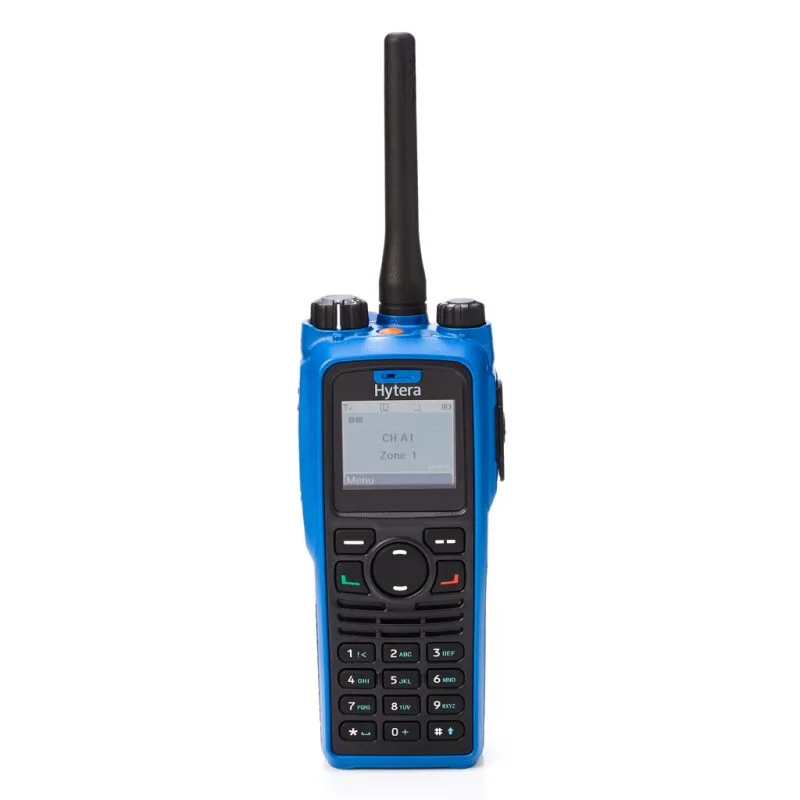
This is backed up by military-grade, rugged hand portables and vehicle-mounted mobile terminals capable of operating in severe conditions, including extreme temperatures or in harsh offshore environments. The radios are designed to withstand impact shock from drops and vibration and have high levels of protection against dust and water ingress.
The terminals come with advanced noise cancelling technology and enhanced audio levels to provide clear, instant (less than 300ms) push-to-talk communications in extremely noisy environments, especially useful for those working outdoors or close to loud machinery.
Hytera radios support several safety features to help protect people and ensure employers meet their duty of care to workers under Health & Safety Regulations. Features include an emergency ‘panic’ button, Man Down and Lone Worker monitoring and alert services.
Many Hytera radios come with built-in GPS, which allows supervisors and control room operatives to pinpoint exactly where workers are located. Not only can managers keep track of who is where in real time, but should anyone get into trouble they can be quickly located and help sent immediately.
The terminals are Bluetooth enabled, which enables staff to be located indoors via beacons. This technology has even been used by companies to provide location services in offshore wind farm turbines. Hytera radios can also support job ticketing and workflow management systems and be integrated with remote alarms.
For those working in potentially explosive environments, Hytera has a range of ‘intrinsically safe’ ATEX compliant DMR and TETRA hand portable radios. Some of the ATEX models are the first radios to be ‘ia’ certified meaning they are safe to use in Zone 0 (where high levels of explosive materials, gases or dust are present continuously).
Another great advantage of PMR radios over mobile phones is their ability to support Direct Mode Operation (DMO). DMO enables users to bypass the main network and communicate directly radio-to-radio so long as they are within range of each other. This enables work teams to communicate with each other when they are out of main coverage area or the network is down.
Modern PMR systems are based on digital IP technology, which enables one or more of the available radio channels to carry a limited amount of data as well as voice services. This allows the radio network to be used for supervisory control and data acquisition (SCADA), telemetry and the Internet of Things (IoT) applications.
Telemetry or radio units fitted to sensors can be used to remotely measure, monitor and control key assets on electricity, gas or water facilities. The unit sends measurements or an alert over the PMR network backbone if an asset malfunctions or is showing indications that it might do so.
Energy and utility companies are using an increasing amount of data. Major PMR manufacturers such as Hytera now enable narrowband PMR systems to be integrated with broadband and other technologies to support this need.
For example, Hytera’s SmartOne software platform can integrate PMR, Wi-Fi, broadband LTE cellular networks, PABX/PSTN telephony, CCTV, vehicle and body worn camera feeds, IoT sensor data, AI and data analytics onto a single unified platform integrated with a full range of dispatching solutions.
The energy and utilities sectors are complex and critical national industries. A robust and reliable communications system is a vital necessity. Hytera’s family of products provides a communication solution to suit any scenario.
IPE Newsletter
IPE publishes a weekly eNewsletter, delivering a carefully chosen selection of the latest stories straight to your inbox.
Subscribe here