

Need to address high level risk
Ensuring safe working at height is an issue faced by many
facilities management teams. Here, Richard Miller, executive
director – sales and marketing – of Nationwide Platforms,
offers answers to a few key questions
Wh
Ensuring safe working at height is an issue faced by many
facilities management teams. Here, Richard Miller, executive
director – sales and marketing – of Nationwide Platforms,
offers answers to a few key questions
What challenges does working at
height pose?
A large proportion of facilities management
tasks take place at height, including both
indoor and outdoor tasks. The challenges
faced by individuals vary depending on the
job, but the issues of productivity and
operator safety would resonate with almost
everyone.
For many, working at height poses a large
barrier to efficiency, but over the past 10 or
15 years powered access has changed that.
Now using this kind of equipment is
becoming an increasing part of maintenance
work as it offers an immediate and highly
safety-focused answer. The trend we are
seeing as a business is that facility managers
are seeking a means of working that is highly
practical and doesn’t have to impact too
much on the people using the premises.
In some instances it is also the only means
of completing building management at
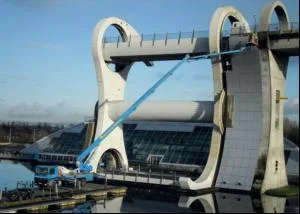
height. For example, recently, one of our
specialist vehicles was used for a maintenance
job on the Falkirk Wheel in Scotland
(pictured). The nature of the environment
meant that for scaffolding to be used the
water would have to be drained – a large
inconvenience for our client. We provided a
machine that enabled work at height up to
50m from a fairly confined location at the
foot of the wheel. The nature of the
equipment we provided was such that the
machine could be driven away from the site
as soon as it has been used.
What trends are you seeing in
ways safe facility management is
achieved at height?
As a business we’re increasingly seeing
businesses put extra priority in the
development and training of their employees.
The potential human and financial costs far
outweigh any price put on safety training,
and it’s getting much harder for those
without the right training to get work. The
International Powered Access Federation
(IPAF), the industry’s safety body, is also
helping in the drive for the highest standards
in powered access operator training.
It is also becoming clear that as businesses
look to cut down on capital costs, many
facility managers are looking to find longterm
solutions that deliver the most
productive methods of accomplishing their
goals. This will often mean businesses
outsourcing work to contractors. While for
the most part this will be an effective way of
working, sometimes there are risks when
contractors don’t see the working at height
risks that an in-house team may have been
more aware of. Of course cutting costs should
never impact on safe working at height.
What steps can facilities managers
take to safeguard those working
at height?
As mentioned above, the appropriate safety
training is crucial, but there are other things
to consider when managing employee safety.
This includes completing thorough risk
assessments and accurately selecting the
right means of access. This in itself could
bring extra stability and precision to an
operator’s means of working.
Where work includes material repairs or
installation, including guttering, piping, light
units or cladding panels, it’s important to
account for that in the appropriate means of
working at height. Reacting to the safety
advice outlined by both the HSE and IPAF,
our business has pioneered its own Material
Handling Attachments (MHAs) range called
BlueSky and it’s possible that innovations of
these kinds will eventually become the norm
for all material handling at height.
Many facility managers are under
increasing pressure to deliver the highest
standards while facing staffing or budgetary
cutbacks. Technology can be crucial in
driving value and finding practical solutions
in long-term projects.
Crucially though, while many of the tasks
performed at height are unavoidable, it’s
important to remember that all working at
height presents an element of risk. It’s for
that reason that health and safety must
always be the first priority when overcoming
any facilities management challenge.
IPE Newsletter
IPE publishes a weekly eNewsletter, delivering a carefully chosen selection of the latest stories straight to your inbox.
Subscribe here