

Noise issues: Back to basics
Confusion still shrouds the understanding of noise
regulations and noise measurement in the workplace.James
Tingay,group marketing manager at Cirrus Research, explains
the basics of self noise measurement recordings and di
Confusion still shrouds the understanding of noise
regulations and noise measurement in the workplace.James
Tingay,group marketing manager at Cirrus Research, explains
the basics of self noise measurement recordings and dispels
the myth that measurement is confusing
The self-reported worker’s survey for
2010/11 estimated that 22,000 people
were suffering from hearing problems
believed to be related to noise in the
workplace. An increased understanding of
the damage noise can do to hearing and the
negative impact it can have on quality of life
in the wider community has resulted in a
growing need to measure noise. The survey,
however, shows that organisations still have a
limited knowledge about how to measure
and record noise.
Regulations
The Control of Noise at Work Regulations
2005 protect persons against risk to their
health and safety arising from exposure to
noise at work. The regulations also list
exposure values to enable employees to
establish whether noise levels are at sufficient
level that work activity should be changed or
hearing protection provided.
The measurements for compliance listed in
the regulations are:
The equivalent continuous A-weighted
sound pressure level (LAeq)
The maximum C-weighted peak sound
pressure level (LCPeak)
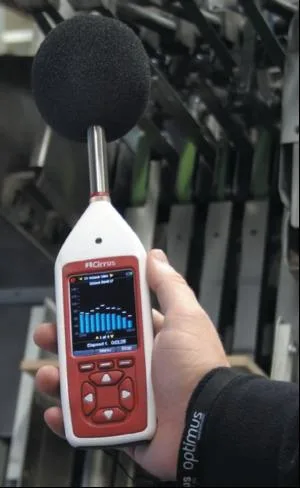
Noise measurement instruments
There are many different types of noise
measurement instruments on the market –
noise meters, noise dosimeters,
environmental noise monitoring systems and
acoustic transducers.Most instruments are
used across a wide and diverse range of
applications including occupational noise,
industrial hygiene, environmental noise
measurement, vehicle noise testing and
airport noise monitoring.
The majority of organisations record
noise on an occasional basis and a basic
instrument is sufficient enough to record the
relevant data to comply with industry
standards.
The performance of sound level meters,
noise dosemeters and acoustic calibrators are
set out in national, European and
international standards. The latest sound
level meter standard gives two levels of
accuracy, Class1 and Class 2. The Control of
Noise at Work Regulations 2005 state that a
sound level meter should meet at least Class
2 of BS EN 61672 – 1:2003. Personal noise
dosemeters have their own standard (BS EN
61252:1997) with which they must comply.
Purchasing
It is often advisable to purchase a sound level
meter as a complete kit. All noise
measurement standards state an instrument
must be calibrated before and after each use
and with an acoustic calibrator. Noise
measurement instruments are precision tools
and the level of accuracy required from them
is very high.
Reputable manufacturers ensure that their
instruments meet these standards; therefore
it is important to keep the equipment at the
same level of accuracy as when it was
purchased.When you are looking at different
manufacturers, ask questions about how
your investment will be supported. A
reputable manufacturer should:
Regularly conduct research into noise
measurement regulations and
requirements to ensure it is kept
constantly up-to-date with changing
needs.
Have an established Research and
Development team that ensures any
equipment contains the latest
functionality to meet all requirements.
Offer free software updates so any
equipment can be used for years to come.
Provide equipment upgrades to easily
change the use of any equipment without
having to reinvest in brand new hardware.
Training
The level of training and experience required
to operate complex sound level meters can
often get in the way of making good quality
noise measurements. Choose an instrument
that meets your practical requirements while
keeping the instrument as simple as possible
and the cost realistic. A product that
provides relevant, important information in
one place quickly makes it easier for
measurements to be reported.
Software
Most noise measurement equipment doesn’t
come with reporting software as standard; it
may only be supplied with basic
downloading software supplied with the
instrument so check what’s included.
Cirrus Research works with organisations
to ensure that they fully understand and
comply with UK Noise at
Work regulations so that
employees are protected
sufficiently to reduce the
risk of long term or serious
hearing damage. Although
organisations are
beginning to understand
the dangers of noise in the
workplace, it is still
imperative to keep up
education about the
dangers of work related
Noise-Induced Hearing
Loss (NIHL).
IPE Newsletter
IPE publishes a weekly eNewsletter, delivering a carefully chosen selection of the latest stories straight to your inbox.
Subscribe here