

Ongoing quest for better bearings
New developments are taking the performance of selfaligning
roller bearings to new levels, as Phil Burge,
communication manager at SKF, explains
Self-aligning bearings were first
commercially developed in 1907 by
Sve
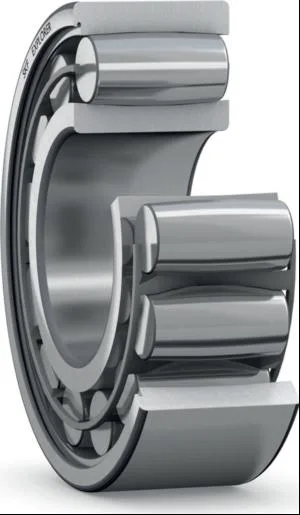
New developments are taking the performance of selfaligning
roller bearings to new levels, as Phil Burge,
communication manager at SKF, explains
Self-aligning bearings were first
commercially developed in 1907 by
Sven Wingquist, who went on to
found SKF in the same year. His
original design has long since
evolved into a robust, high
performance component that
today accounts for around 25%
of all bearings sold worldwide.
Despite its age and ubiquity,
the self-aligning bearing is still
being developed today. Indeed,
just when many thought that
the technology had been
stretched as far as it was likely to
go, engineers at SKF have made
a breakthrough that can
potentially double the operating
life of self-aligning roller bearings
in contaminated environments. As
this type of environment accounts
for about 75% of all self-aligning roller
bearing applications, the new developments
represent an important step forward.
The improvements have been achieved by
a combination of factors: New component
design, in terms of the structure of the roller
and raceway geometries; the
use of floating guide rings and
the interaction between
inner and outer raceways;
plus, most importantly,
developments in the
mechanical properties of
the Bainite steels used in
the raceways and rollers.
The production process
for manufacturing bearing
steels has remained
fundamentally unaltered
for some time. A sequence
of processes are used to
create a material that has an
optimised balance of
properties derived from a
combination of elements that
include carbon, chromium,
nickel, phosphorous or manganese. During
manufacture, the bearing steel is heated to
extreme temperatures, which alter its
crystalline structure until it reaches a
state known as Austenite. Rapid
cooling then transforms the
structure again, to Martensite,
with the rate of cooling
determining the mechanical
properties of the steel. A further
option is to hold the steel at
a fixed temperature for a
long period, which results
in a far tougher material
with excellent levels of
hardness; this was
discovered by Davenport
and Bain in the 1920s and
has since become known
as Bainite.
Since its introduction on a
commercial scale, Bainite
hardening has been further
developed, with modifications in the
1990s to the transformation stage
of the hardening process
helping to increase toughness,
dimensional stability, wear
resistance, surface
compressive residual
stresses and fatigue life.
At one point it was
considered necessary to
maintain a low temperature
for prolonged periods during
the process of Bainite
transformation, to achieve
optimum results. However, it has
recently been recognised that
once the Bainite transformation has
developed to a certain stage at an extremely
low temperature, it will continue to develop
the desired properties in the same manner
even if the temperature is increased to create
additional properties. This creates a much
finer microstructure that offers even greater
wear resistance, yet retains the dimensional
stability characteristics of existing Bainite
steels.
Combining these newly modified
materials with advanced manufacturing
techniques and revised designs allows
bearing components to be engineered to
even greater levels of dimensional precision.
Among other benefits, this has resulted in
refinements to the geometries of internal
rollers and raceways. This has minimised
bearing osculation, while giving higher
contact interface tolerances and, in turn,
helping bearings to run more smoothly and
effectively with reduced friction and fretting
corrosion.
The increased hardness now being
achieved in the manufacture of Bainite
bearing steel also makes the raceways less
prone to indentations; when indentations are
made, they are smaller, resulting in improved
performance and extended life.
In practical terms, because the surfaces of
the raceways are more resistant to metal-onmetal
contact, it means that bearings can
provide twice the service life under poor
lubrication conditions of their previous
equivalents. This is significant, as research
has shown that 36% of all bearing failures
result from the use of incorrect lubricants or
poor lubrication practices, which
dramatically increase metal-on-metal contact.
The use of a floating guide ring represents
another important innovation in the latest
design of bearing. This ensures that the
correct roller position under load is
maintained at all times, producing a stable
operating temperature within the bearing
while simultaneously reducing friction and
wear. The floating guide ring also maintains
the correct axial loading of the bearings
while securing unloaded rollers in position.
This critical area of bearing
design directly contributes
to a reduction in
vibration and noise
levels and enables
safer, more efficient
operation with
extended life.
Combined, these
recent
developments in
self-aligning roller
bearing technology
have the potential to
help OEMs and end
users improve the
performance, reliability
and operating life of rotating systems. In
particular, in demanding applications with
high levels of contamination, where in the
past failure rates have been proportionally
higher, the advent of these recent
developments will offer considerable
benefits.
IPE Newsletter
IPE publishes a weekly eNewsletter, delivering a carefully chosen selection of the latest stories straight to your inbox.
Subscribe here