

Open to energy saving ideas
Sustainability and energy efficiency are driving new
product developments for the handling and storage
industry. Here, Hörmann explains the thinking behind some
of its recent door developments
As more and more compani
Sustainability and energy efficiency are driving new
product developments for the handling and storage
industry. Here, Hörmann explains the thinking behind some
of its recent door developments
As more and more companies target
their supply chain as an area to
improve their carbon footprint, new
products and designs are being created to
add to both operational and efficiency
energy consumption. As a leading
manufacturer of industrial doors and
loading bay equipment, Hörmann is at the
forefront of change with new products being
developed and new ideas explored.
The company reports an increase in the
use of fast action doors to partition existing
buildings, in order to maintain temperatures
and minimise draughts. These energy saving
benefits have also led to greater use of such
doors on conveyor systems, where they offer
the added benefit of noise reduction. This
has led to the introduction of specific doors
for conveyor systems but has also accelerated
the need for better, more integrated safety
systems as having more doors increases the
risk of potential collisions with lift trucks
and pedestrians.
Doors that can withstand impact and
‘repair’ themselves by simply relocating, and
leading edge safety devices that detect
obstructions are widely available and present
the operator with a number of choices.
However leading edge devices can be
damaged and those that rely on battery
power need to be monitored closely, to
ensure they are working. These concerns
have led to the development of integrated
solid state systems, such as Hörmann’s Light
Grille, that monitors the door opening to a
height of 2.5m and automatically halts door
travel, if any of the array of light beams are
broken.With no moving parts, maintenance
is minimal and collision damage unlikely, as
the device is contained within the door frame.
In a warehouse the loading bay area can be
critical to energy usage.Minimising the time
doors are open and increasing insulation in
this area can add up to significant cost
benefits. An obvious development is better,
thicker insulation, but less obvious is
identifying the design options and
developments that can add value in terms of
savings and improving operational efficiency.
Simple design considerations when
refurbishing existing loading bays or
developing new ones can save energy and
reduce your carbon footprint. Techniques
developed for cold storage are now being
applied to all loading bays. A good example
is designing the bay so an insulated door
closes in front of a dock leveller, preventing
the steel from acting as a thermal bridge.
This requires a dock leveller with a telescopic
lip and demonstrates that all the key
elements are interlinked.
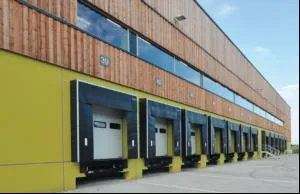
This technique was used for all 40 loading
bays on a new 222,000ft2 distribution centre
for organic food retailer Alnatura, in what
was a project for the German Sustainability
Council. The development relies on
renewable energy sources to heat and cool
the building, hence the loading bays are
critical. As well as the door design, cushion
dock seals on the exterior create a seal
between containers and the building, that
keeps out cold winter and hot summer air.
An additional energy saving measure is the
inclusion of double glazed panels in the
insulated doors. These allow in natural light,
reducing the need for powered light sources,
yet maintain the high level of insulation the
door provides.
With new products and new thinking
being applied, Hörmann has developed a
free, on-line, modular planning tool, the
Energy Saving Compass. This guide examines
the key aspects of energy saving that can be
affected by industrial door systems and
loading technology solutions. The six themed
modules give examples of well-planned
loading bays and the options available, as well
as an energy loss calculator. Not only is it
possible to assess potential savings but the
projected pay back time for any investment
can also be calculated: www.hormann.co.uk
(click the link on the welcome page).
Overall the demand for better energy
efficiency will continue to drive the
development of new solutions, whether this
is through equipment or working practices.
Good planning will maximise the benefits
available, as more integrated systems can add
to safety and also reduce the number of
components that need to be maintained and
managed. For the warehouse operator and
developer, accessing high quality advice at
the planning stage whether for
refurbishment or a new development is
going to pay dividends in the long term.
IPE Newsletter
IPE publishes a weekly eNewsletter, delivering a carefully chosen selection of the latest stories straight to your inbox.
Subscribe here