

Packaging for every product
There are plenty of options available for protecting products
during transit.Tom Wetsch, global vice president of new
product development at Pregis, outlines some of the solutions
Every manufacturer wants to ensure tha
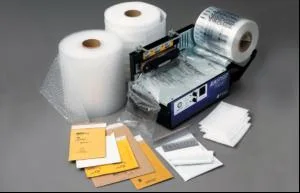
There are plenty of options available for protecting products
during transit.Tom Wetsch, global vice president of new
product development at Pregis, outlines some of the solutions
Every manufacturer wants to ensure that
its products arrive at their destination in
the same condition as when they left.
The wide variety of protective packaging
alternatives means that, for almost every
product, there is a solution available.
Products that need to be wrapped may
require bubble or air cushioning. These feature
rows or cells of ‘bubbles’with trapped air locked
between layers of low-, linear-low density or
co-extruded polyethylene film. These materials
provide shock and vibration protection,
interleaving and surface protection.
Resilient and flexible, the material can be
tailored to the needs of a huge range of
products, from delicate
lightweight objects such as
ceramics and housewares to
bulkier and heavier glassware
and electronic components, for
which bubble packaging with
anti-static properties is available.
Alternatively, the main
requirement may be to provide
void fill in order to create
effective blocking and bracing,
where inflatable bags and air pillows or
crumpled paper are some of the options.
Inflatable bags and air pillows offer the
lightest weight void-fill option and are
usually created on demand at packaging
stations and then inserted into a box. The
deflated rolls of air-pillow film take up less
than 1% of the inflated volume, which
enables manufacturers to maximise truck
and warehouse space. Air pillows will
provide protection and keep in place a wide
range of products. They come in a variety of
widths and perforation dimensions.
Another flexible protective packaging
solution is EPS (Expanded Polystyrene)
which comes in the form of moulded end
caps, blocks, sheets or loose-fill void-fill
commonly referred to as ‘peanuts’. Benefits
include light weight, low cost and there is
potential for re-use.
Padded mailers are also an important
protective packaging option, shipping
everything from books to parts. Plastic based
alternatives, which are lightweight and
waterproof, are normally made from
polyethylene and can include a bubble inner
layer. ‘All paper’ padded mailers create
their additional protection with macerated
paper between the inner and outer layers.
Custom fabricated foam, foam-in-place,
honeycomb structures and moulded pulp are
suitable protective formats for large, unusual
or awkward shaped products and can be
tailored to fit their precise dimensions.
Foam structures are made from
polypropylene or polyethylene in a wide variety
of densities and thicknesses. Clean and nonabrasive,
sheet or plank form offers shock
absorption, vibration dampening and
cushioning to provide case inserts, end caps
and bottom and top cushioning for anything
from electronics to household accessories.
Foam-in-place polyurethane is moulded
in real time by mixing two liquid chemicals
contained in a thin, low-density polyethylene
bag. The mixture expands rapidly around the
product being protected, providing a
solution tailored to its precise dimensions.
Hexagonal honeycomb structures are one
of the most frequently used paper-based
protective packaging forms.Made from 100%
kraft paper (linerboard) and water-based
adhesives, honeycomb structures are available
in sheets, edge and corner protectors, runners,
blocks and pallets, and offer excellent strength,
cushioning and blocking/bracing functions.
Moulded pulp protection solutions are
made from a combination of recycled
newspapers and corrugated, and can be
moulded into a variety of shapes to meet
specific applications.
An area that has seen much recent activity
has been the incorporation of environmental
considerations into protective packaging
solutions. Paper has always enjoyed a strong
environmental profile and many paper-based
options include a recycled content and are
recyclable; equally some bubble products
now incorporate industrial or postconsumer
waste while air-pillow film can be
made of bio-degradable materials. Other
considerations, such as the overall weight or
dimensions of the pack and how these
impact on transport costs and overall carbon
footprint, are equally important.
With so much choice available, talking to a
protective packaging specialist is important.
By fully understanding the particular needs
of each application, the supplier can suggest
a format that delivers the correct amount of
protection without using excessive material
and is able to fully withstand the rigours of
the product’s distribution chain.
Such dialogue is also vital in the
development and enhancement of products
to meet changing market needs and to
ensure that all protective packaging solutions
continue to provide the maximum balance
of protection and cost-effectiveness.
IPE Newsletter
IPE publishes a weekly eNewsletter, delivering a carefully chosen selection of the latest stories straight to your inbox.
Subscribe here