

PASMA reviews fall protection issues
The Prefabricated Access Suppliers’ and Manufacturers’
Association (PASMA) has completed its long awaited review
into recommended best practice for the avoidance of falls
from height when using mobile access towers.Here, t
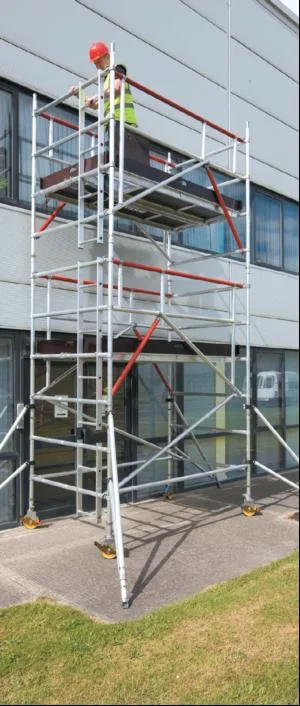
The Prefabricated Access Suppliers’ and Manufacturers’
Association (PASMA) has completed its long awaited review
into recommended best practice for the avoidance of falls
from height when using mobile access towers.Here, the
Association outlines its findings
Driving standards and best practice,
and overseeing the delivery of the
national training scheme, PASMA, is
the trade body for the mobile access tower
industry in the UK and Ireland. A founder
member of the Access Industry Forum
(AIF), it provides advice, guidance and
support to its members and the industry at
large. Building a positive, proactive safety
culture is central to its role.
Against this background the Association
has recently completed its long awaited
review into recommended best practice for
the avoidance of falls from height when
using mobile access towers. The review,
which took 16 months to complete, was
carried out in collaboration with the Health
& Safety Executive (HSE) and represents a
significant milestone for the industry.
According to PASMA, the 20-page report
brings clarity to the use of Through the Trap
(3T) and Advance Guardrail (AGR) methods
for assembling, altering and dismantling
mobile access towers.
The report concludes that when used in
accordance with manufacturers’ instructions
and guidance, both methods continue to
provide an acceptable safe method of work,
with AGR systems providing
comprehensive fall protection
and the 3T method using
conventional components to
minimise the risk of a fall.
As suggested by HSE, part
of the review included
ergonomic research
undertaken by the Health
and Safety Laboratory into
various aspects of tower
assembly using both
methods. The HSL
concluded that ‘with
correct manual handling
techniques and body
positioning, the risks to
manual handling related
musculoskeletal health were kept within
tolerable limits in both processes’.
The PASMA technical committee, which
led the review, also considered the stiffness of
integral type AGR towers built with reduced
component counts and concluded that ‘there
were no observed problems with the stiffness
of towers complying with EN1004 built
using AGR components’.
It considered a proposition that there is a
potential for incorrectly assembled
conventional (3T) towers to collapse.
Following review, the committee decided
‘the risk of reducing the structural integrity
of a conventional tower sufficient to generate
a risk of collapse through an assembly
entirely contrary to the recommended
bracing pattern was inconceivable, except at
the very outermost extremes of the
performance envelope of an EN1004 tower’.
The committee also considered the
corresponding possibility that a tower built
using an integral AGR system could be at
risk of collapse as a result of totally incorrect
assembly. The committee similarly
concluded that the risk was equally
inconceivable and therefore equally
immaterial.
Significantly for the thousands of tower
users in the UK and Ireland, having
considered the outcome and implications of
the review, the PASMA training committee
concluded that current PASMA cardholders
do not have to re-train until their card has
expired at the end of the normal five year
period. It decided that the content of the
current PASMA training course was
sufficient to provide an acceptable working
knowledge of the AGR process. However, it
did conclude that the Association’s standard
‘Towers for Users’ course could be enhanced
by extending the existing content to cover
the latest developments in AGR systems,
particularly integral type products.
Peter Bennett, PASMA’s MD, comments:
“The review process was commissioned by
PASMA as a measured, impartial and
prudent exercise five years after its first
guidance was issued, and in response to
representations from tower manufacturers in
support of a new generation of integral
AGRs.
“PASMA is now engaging with duty
holders to reassure them that both 3T and
AGR systems remain equally acceptable to
both the Association and HSE.”
The review process involved soliciting
input from stakeholders to identify the issues
to be investigated, the production of an
interim report detailing these issues, practical
technical workshops and a training
workshop to examine all the issues in detail.
It included the commissioning of
independent, expert research by Health and
Safety Laboratories to examine specific
ergonomic questions, and the issuing of a
briefing report to a wide range of
stakeholders as part of a consultation
exercise to wider industry.
A copy of the report, which contains a
number of other observations and
recommendations – particularly in regard to
the enhanced coverage of AGR in the
practical element of PASMA training – can
be obtained from the Association’s website:
www.pasma.co.uk.
IPE Newsletter
IPE publishes a weekly eNewsletter, delivering a carefully chosen selection of the latest stories straight to your inbox.
Subscribe here