

Preparing to be upwardly mobile
Brian Parker, health, safety & environmental quality
manager for powered access hire specialist AFI-Uplift
highlights some of the factors to consider before using a
Mobile Elevating Work Platform (MEWP)
It is essentia
Brian Parker, health, safety & environmental quality
manager for powered access hire specialist AFI-Uplift
highlights some of the factors to consider before using a
Mobile Elevating Work Platform (MEWP)
It is essential that before carrying out any
work at height you carry out a risk
assessment and produce a method
statement. These should be communicated
to all who are going to carry out the work
and people in the vicinity of the work.
If the risk assessment confirms that there
is no alternative to working at height, then
the employer should select the most
appropriate equipment to minimise the risks
of a fall.Where a risk assessment or the
nature of the work indicates that a Mobile
Elevating Work Platform (MEWP) should be
used it is imperative that the correct type of
machine is selected.
Selecting a MEWP
When selecting a MEWP it is advisable to
use a reputable powered access equipment
supplier so that you receive the most
appropriate advice and the most suitable
machine. Check that the supplier can carry
out a site visit, if necessary, to advise on the
best machine for the job in hand. Also
ensure that the supplier provides service
support, including an out-of-hours service.
You should ensure that your supplier has
followed LOLER 1998 legislation (Lifting
Operations and Lifting Equipment
Regulations) by seeing evidence that they
have carried out a six monthly thorough
examination of the machine. This evidence
could be either a certificate or a sticker on
the machine.
Training
Many suppliers of MEWPs for hire will be
able to meet your training needs by being
accredited providers of IPAF (International
Powered Access Federation) training or
CPCS (Construction Plant Competence
Scheme) training. No-one can legally operate
a MEWP if they do not have one of the
following – an IPAF PAL (Powered Access
Licence) card, a CPCS operator’s card, a
NPORS (National Plant Operators’
Regulations Scheme) card, or a RTITB (Road
Transport Industry Training Board) card.
To gain the five-year PAL card you have to
attend an IPAF operator’s course. Because
the courses cover a wide range of machines
sizes – for example an IPAF scissor lift course
will enable an employee to operate
everything from a 6m scissor through to a
34m scissor – there are significant differences
in size, weight and the complexity of the
machines. It is therefore recommended that
employees also receive specific machine
familiarisation training before any new
MEWP is used.
Under PUWER (Provision and Use of
Work Equipment 1998) anyone who
supervises or manages work equipment must
also receive training to ensure that the
employee is working safely at height by
attending an IPAF MEWPs for Managers
course.
Hazards
There are many hazards to be considered
before using MEWPs, including ground
features such as trenches or manhole covers,
slab loading limits, wind speed, and overhead
structures against which the operator could
be trapped. The operator must have
sufficient visibility during reversing, and
people working below a MEWP must be
protected from the risk of falling objects.
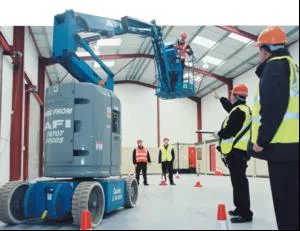
Ensure that the area around the MEWP is
barricaded using cones and warning signs.
Unfortunately, safety abuses are still all too
common. These include standing on guard
rails to gain additional height, getting out of
a platform at height to climb onto the work
area, tying open entry gates, lowering a
scissor lift while the deck is still extended,
using a machine that is too big for the work
area (which leads to the risk of crushing
injuries), using machines in high winds,
overloading machines with people and
materials, and charging an electric machine
in a confined space (this process produces
potentially explosive hydrogen gas).
Emergency plan
An emergency and rescue plan for MEWP
occupants must be drawn up to deal with
instances where the machine is unable to be
lowered for any reason, such as machine
malfunction or platform entanglement.
Rescue might also be necessary in the event
of illness, injury or risk of exposure. The plan
should identify trained, site-based personnel
who would be available to lower the
platform using the machine’s ground
controls, emergency power pack or manual
bleed down systems. If this is not possible,
another MEWP may be used to carry out the
rescue, although this should only be done
once a site specific risk assessment has been
carried out and a specific plan drawn up.
Emergency drills should be completed by
all personnel to ensure that all persons know
how to lower the machine in the event of an
emergency.
IPE Newsletter
IPE publishes a weekly eNewsletter, delivering a carefully chosen selection of the latest stories straight to your inbox.
Subscribe here