

Press technology: Selection matters
There are various sorts of press technology on the market
today. Here,Roger Ilett, general manager for Schmidt
Technology, looks at the different types available and
suggests how to choose the correct model for the applica
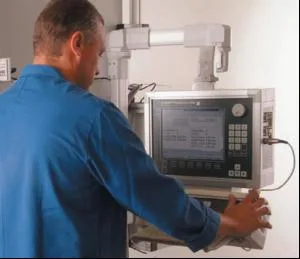
There are various sorts of press technology on the market
today. Here,Roger Ilett, general manager for Schmidt
Technology, looks at the different types available and
suggests how to choose the correct model for the application
Press assembly technology has undergone
considerable development in recent
years. It has evolved from simple handoperated
presses, through pneumatic or hydropneumatic
presses with force and stroke
monitoring, to sophisticated electromechanical
servo presses. Manual presses rely on an
operator input for control, while more
advanced systems are capable of providing
almost unlimited control options with
previously unachievable levels of precision
and repeatability, in a wide range of industries
such as automotive, aerospace, medical,
petrochemical, testing and processing.
Servo presses are becoming increasingly
common and can essentially be grouped into
three main categories. These range from the
most basic models that feature a simple
servo actuator mechanism with a motor and
spindle, used to generate force, through
advanced units with a range of control
devices, to highly intelligent, fully integrated
purpose built systems with real time data
processing, closed loop force control and
dynamic compensation for system, tooling
and part compression and relaxation.
While these diverse presses offer an
impressive range of features that meet the
functionality needs of many production
tasks, including assembling, flaring, joining,
pressing, testing, bending,
embossing, forming, stamping
and riveting, choosing the
correct press for each specific
application is not always
straightforward.
In today’s economic
climate, there is no room for
costly mistakes, so the
specification of
electromechanical presses
requires careful thought to
achieve the ideal solution.
What is needed is an
understanding of the
differences between the
various press types.
Basic
A basic servo actuator, for example, is
normally used in automation machines for
simply moving parts between locations;
these devices, however, are also suitable for
basic pressing operations, acting as a ram
unit. Basic presses provide users with the
flexibility to control both the ram position
and speed. They cannot provide true closed
loop force control, but instead measure force
via the torque of the motor or by using an
externally mounted load cell. Depending on
the specific needs of each application, a
variety of control packages can be included
and the options vary depending on the
supplier and system builder used.
High end
On the other hand, high end servo actuators
that have been designed to function as
presses often feature several additional
mechanical components, including planetary
roller screw spindles for higher forces,
mechanical clutches, integrated load cells
and guided anti-rotational rams. In terms of
control, there are various software
programmes available that can monitor and
manage the press operation; they are not,
however, capable of providing true closed
loop force control.
Sophisticated
The most sophisticated servo press systems
effectively incorporate all the features of high
end servo actuators and servo press systems,
as well as using other additional
components, to significantly increase
functionality and enable users to produce
extremely high quality parts. These systems
often use completely integrated controls,
designed specifically for pressing
applications, to monitor the total pressing
operation and achieve high levels of
precision, while high speed data
transmission capabilities enable real time
processing, providing true closed loop force
control.
Furthermore, these high performance
systems have been specifically designed to
operate in industrial environments and, as
such, feature integrated safety circuits, to
minimise any electromagnetic interference
(EMI) present in the surrounding area, as
well as incorporating a motor cooling
system. The latest servo press systems, such
as those from Schmidt Technology, are also
typically modular in design and use proven
technology to offer both OEMs and end
users an extensive range of options in many
different applications.
By comparing these differences in
mechanical design, while looking at how the
systems control and monitor both position
and force during the press cycle against your
specific needs, you will be able to select the
right device, whether it be a manual,
pneumatic, hydro pneumatic or servo press
system.
Indeed, by paying particular attention to
factors such as throughput rate, accuracy,
repeatability, the degree of automation
required and system integration, your
correctly specified press will start to play an
important role in enhancing product quality,
improving process performance and
increasing productivity.
IPE Newsletter
IPE publishes a weekly eNewsletter, delivering a carefully chosen selection of the latest stories straight to your inbox.
Subscribe here