

Profit from a cut in waste
With the cost of raw materials continuing to rise,Dawson
Shanahan believes many companies could reduce costly
material waste by adopting precision cold forming
The cost of almost all the common
metals used as raw mate
With the cost of raw materials continuing to rise,Dawson
Shanahan believes many companies could reduce costly
material waste by adopting precision cold forming
The cost of almost all the common
metals used as raw materials in the
production engineering sector has
been rising steadily in the last year. For
example, the price of copper jumped by over
60% between May 2009 and April 2010, with
predictions that it could reach $8000/t
following disruption to supplies following the
major earthquake earlier this year in Chile,
the world’s largest producer of copper ore.
Similarly, aluminium prices have risen by
around 50% over the same period. Although
steel products are trading some
way off their highs of a few
years ago, the overall change
in prices moves relentlessly
upwards. It’s reasonable to
predict that although there
may be short term
fluctuations this upward
trend in raw material prices
will continue, as the global
economy recovers and
demand increases,
especially in Asia and the
Far East. Indeed, Rio Tinto,
the world’s second largest
ore mining business, reported
recently that most of its
operations are running at full capacity, largely
as a result of strong demand from China and
India.
For UK manufacturers purchasing raw
materials in Sterling, this problem is likely to
be exacerbated as the world’s commodity
markets generally trade in the US dollar;
although this currency has fallen in value
against the pound, it still remains relatively
strong and looks, with the scale of the
financial deficit in the UK, set to stay that way
for the foreseeable future.
One option for manufacturers is simply to
increase the price of goods leaving the factory
gates, to protect their profit margins. In
practice, however, this is not always possible,
especially at a time when the UK is struggling
to free itself from the grip of recession, with
depressed levels of local demand, or where
manufacturers have to compete in
increasingly tough export markets.
Further options include efficiency savings,
although with most businesses already
running extremely lean operations, there is
limited potential for shaving costs still
further; additionally, a switch to lower cost
materials may be possible, as long as the
required characteristics of the finished
products can be retained.
Changing methods of production can, in
many instances, also offer an interesting
option, especially if existing engineering
processes involve milling, drilling and
grinding. In particular, these processes can
generate considerable quantities of waste
material that although reclaimable has,
ultimately, to be paid for. For example,
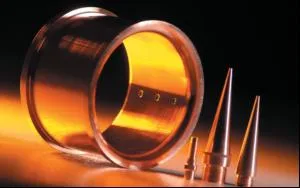
machining a typical copper nozzle used in
plasma or laser welding applications, with a
finished weight of 36g, requires a block of
metal weighing 213g from which the shape
can be milled. This generates 177g of waste
material; in other words, more than 80% of
the total starting weight of metal is wasted –
at current copper prices that’s well over £1 of
material wasted per component.
Although not all components can be
analysed so simplistically there are many
parts where material is being needlessly
wasted, and where production cost can be
significantly reduced, by considering
alternative methods of production.
One option is precision cold forming,
where a billet of metal is extruded using a die
and punch under high pressure; typically, this
is around 100t in a specially designed press,
although for some materials or larger
components pressures can increase to 2000t
using orbital presses.
Precision cold forming is an established
process and although it is widely used in a
range of niche applications, Dawson Shanahan
believes it deserves wider consideration, as it
offers a number of benefits. Perhaps most
importantly, because parts are extruded from
a small billet of metal, it is possible to make
considerable reductions in waste material.
Using the same example of a copper laser
nozzle, only a 54g billet would be required,
producing a fully shaped part that simply
requires final machining; waste is therefore
reduced to just 18g or about £0.12 in cost.
Additionally, precision cold forming can
produce highly polished surfaces, without the
need for extensive finishing and with often
complex internal geometries in a wide range
of metals, including copper, brass, steel and
tungsten. The process also improves the
mechanical properties of the finished part
where, unlike machining where sections are
usually cut across the grain structure of the
material, the direction of forming and the
geometry of the part is aligned with that of
the grain structure.
Precision cold forming may not be the
perfect solution in all cases, but as an
engineering process it deserves greater
consideration as part of manufacturers’
portfolios of production options. At a time of
rising raw material costs, precision cold
forming can provide a valuable method of
protecting profit margins.
IPE Newsletter
IPE publishes a weekly eNewsletter, delivering a carefully chosen selection of the latest stories straight to your inbox.
Subscribe here