

Programmable approach to safety
As programmable safety relays become more affordable
and new regulations support their use, it makes sense to
deploy them more widely.Paul Considine of Wieland Electric
considers the time and cost savings that can be ach
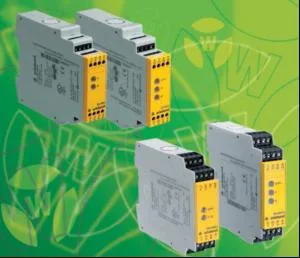
As programmable safety relays become more affordable
and new regulations support their use, it makes sense to
deploy them more widely.Paul Considine of Wieland Electric
considers the time and cost savings that can be achieved
One of the key advantages of moving
towards EN ISO 13849-1, in line
with the new EU Machinery
Directive, is that it enables much wider use
of programmable safety relays. At the same
time, these programmable products are
becoming more affordable,
even for smaller projects. All
of which creates opportunities
for cost-savings when
compared to stand-alone
relays, as well as higher levels
of safety.
The associated time and
cost savings from
programmable safety relays
begin at the early design
stages and go right through
to everyday operations. For
instance, when designing a
system within specially
designed software the safety
circuits can be tested before
even going to site.
In contrast, when using stand-alone safety
relays in systems with interlocking between
just a few sub-systems, considerable time is
required on site to test and re-test the hardwiring.
Similarly, working out the hard wiring
feedback protocol can be very complex using
traditional methods, whereas a flexible logic
editor will flag up potential problems so they
can be designed out.
In parallel, programmable safety relays
simplify the wiring enormously, as all of the
components are simply wired back to a
central I/O point. Thus, it avoids the
extensive wiring required to provide
feedback loops and interconnecting
terminals that is the norm with stand-alone
relays. A major benefit of this is that
installation time is greatly reduced, which
should have an impact on the overall cost of
the project.
As a consequence of this, the overall
number of sub-systems is reduced which ties
in well with one of the key objectives of the
Machinery Directive, as it is widely accepted
that the more complex a system, the more
likely it is that faults will occur. In this way, a
switch to programmable safety relays reduces
the risk of faults and helps to achieve higher
performance levels, as detailed in EN ISO
13849-1.
In addition, programmable systems offer
constant test outputs to provide a complete
diagnostic monitoring system that delivers
cover at the highest possible level.While it is
possible to do this using stand-alone safety
relays the wiring is complex and therefore
expensive. Furthermore, programmable
systems enable a full diagnosis through the
software – something that can’t be done with
stand-alone systems.
Clearly, the diagnostic capabilities of such
systems make it easier to identify faults and
remedy them, resulting in reduced downtime
as well as less input from specialist engineers
charging by the hour.
These same principles also apply to the
commissioning of the system, as the software
spots any errors and helps to speed up the
whole process, again saving time and money.
And if the original settings are saved it is
relatively easy to restore the system to its
original settings if someone ‘tweaks’ a
parameter and finds it doesn’t work.
Tied in to this is a full reporting structure
that enables reports to be generated
automatically and added to the technical file,
avoiding all of the time often dedicated to
producing reports manually. These reports
can also be used to focus maintenance
resources in the areas that most need them.
Of course, programmable safety relays
have been around for some years but they
have tended to be quite expensive. The takeup
has also been quite slow because they
could not be used with the EN 954-1
standard that is currently being phased out.
As the new standards come in, work by
our company in this area has adopted a
modular approach while also taking
advantage of newer processing technologies,
to drive these costs down and produce highly
affordable systems. As a rule of thumb, a
system using 3-4 stand-alone safety relays
could achieve the additional benefits
described above for around the same price,
while it’s reasonable to expect significant
savings in more extensive systems. Even for
smaller systems many operators are finding
that a slightly higher price is well worth
paying for the benefits that are achieved.
With newer systems due to be launched
within the next few months, I believe that
this is the right time to be taking a fresh look
at programmable safety relays.
Related posts
IPE Newsletter
IPE publishes a weekly eNewsletter, delivering a carefully chosen selection of the latest stories straight to your inbox.
Subscribe here