

Rack up the safety checks
Regular inspections of storage equipment are essential to
ensure employee safety, explains Alex Ashcroft, installation
& projects manager,Construction Group UK
It is a requirement of the HSE, as detailed in
‘Health &
Regular inspections of storage equipment are essential to
ensure employee safety, explains Alex Ashcroft, installation
& projects manager,Construction Group UK
It is a requirement of the HSE, as detailed in
‘Health & Safety in Wholesale and Retail
Warehouses’, that racking and shelving
storage systems must be installed, used and
maintained correctly to protect against injuries.
Similarly it is essential that warehouse staff work
in a safe environment where equipment is
regularly checked for damage and defects.
If a racking system collapses it can lead to
major injury or even death. Racking is made
from relatively light components and
consequently is susceptible to damage. Any
damage will reduce its loading capacity.
Eventually the racking will collapse even when it
is within specified safe load limits. Prevention is
always better than the cure, and is less expensive.
Periodic rack safety audits make good business
sense and are a key component of every
warehouse’s successful planning and operation.
In general terms, storage equipment comes
in two categories – shelving and racking.
Shelving is for pedestrian picking, handloaded
applications and as such, under normal
use, sustains little damage. Racking, however,
is constantly being loaded and unloaded
with mechanical handling equipment and is
more susceptible to damage.
The HSE and The Storage Equipment
Manufacturers Association (SEMA) give the
following areas to look at for potential
problems:
Beams: Missing beam locks/pins; bent/
deformed beams when unloaded; dislodged
beam connectors; damaged beam profiles.
Uprights: Front impact damage (limit 5mm);
Side impact damage (limit 3mm); damaged/
missing braces; damaged/missing floor
fixings.
The limits quoted are measured by using a
simple 1m long straight edge held against the
racking upright. The damage/deflection is
measured in the centre of the straight edge.
It is essential that companies use qualified
forklift truck drivers who should only be
expected to work within their capabilities.
Not only is it necessary to use the right type
of truck intended for a particular
installation, it is important to ensure that the
layout of the racking system provides good
access for that vehicle with adequate aisle
widths free from obstruction.
Pallets and decking can be a potential cause of
damage. Broken or poor quality pallets can
cause premature beam failure by putting
outward pressure on the inside faces of the
beams. Dropping heavy goods on to decking,
overloading, or forcing items into place can
cause them to weaken and become unstable.
Other rack accidents occur when the structures
are not properly secured to the floor slab or
when unsecured beams are dislodged. Improper
loading, either by exceeding capacity constraints
or not placing the pallet’s squarely on the
decking can cause it to either tip off the front
or back of the rack or to push another pallet off
an adjacent rack in a double-deep situation.
Protecting racking
Collisions between forklifts and racking are a
relatively common occurrence in a busy
warehouse.Where racking is likely to be
struck by vehicles it should be protected with
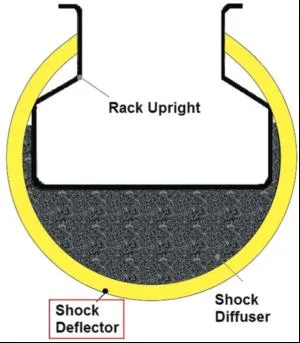
column guards or rail systems. Semi-flexible,
moulded plastic guards, such as Rack Armour
or Protect-it products, are quickly attached
to racking or building columns to form a
protective bumper. They reduce the power of
fork truck impact that can easily damage the
structural integrity of racks and floors
leading to health and safety issues and
expensive repairs. They are designed to fit all
standard European racking uprights and are
easily fitted around the feet of racking
systems and secured by Velcro straps. They
deflect any impact energy away from the
racking to provide effective protection
against most collision damage.
In addition to upright protection, rackend
protection, guide rails and tunnel guards
there is netting and wire mesh backing and
safety signs, which include safe working load
markings and maintenance signs.
Maintenance contracts
When there is a high degree of activity in the
warehouse, it is especially important that trained
and competent rack safety personnel regularly
inspect the racking system. When a forklift has
struck a rack, one of the first priorities should be
to identify any unsafe components in order to
reduce the dangers of collapse. Specific
precautions and taking damaged racking out
of service immediately may be the only
prudent response to prevent possible risk of
injury to personnel caused by continued use of
damaged racking. Rack safety is the employer’s
moral responsibility and comes with
substantial legal liabilities (civil and criminal).
An audit will help in ensuring the number of
incidents is kept to a minimum. It will examine
the set up of the warehouse and help identify a
pattern of operation that may be contributing to
rack damage, or that additional training,
signage, or upgraded rack protection systems are
required.A racking maintenance contract with a
respected company ensures compliance with
health and safety regulations. The Workplace
(Heath, Safety & Welfare) Regulations 1992,
states: “The workplace and the equipment,
devices and systems to which the regulation
applies shall be maintained in an efficient state,
in efficient working order and in good repair.”
The PUWER Regulations states that audit
period should not exceed 12 months. Section
5 states “…equipment to be maintained in an
efficient state, in efficient working order and
in good repair” and that repairs,
modifications, maintenance and servicing are
restricted to competent personnel.
The contracted company will arrange for
trained technicians to make a site visit and
inspection to provide a detailed assessment
of the storage system and layout. A report
will be sent to the customer highlighting any
damaged, missing or badly fitted component
and detailing any replacements and repairs
needed. Such contracts give peace of mind to
the employer and provide a written history
for health and safety inspectors and
insurance companies.
IPE Newsletter
IPE publishes a weekly eNewsletter, delivering a carefully chosen selection of the latest stories straight to your inbox.
Subscribe here