

Respirators: Choice matters
With so many different forms of Respiratory Protective
Equipment (RPE) on the market, choosing the correct form
of protection can be confusing. Here, Mark Andrews,
product manager Air Purified at Scott Safety, helps
navig
With so many different forms of Respiratory Protective
Equipment (RPE) on the market, choosing the correct form
of protection can be confusing. Here, Mark Andrews,
product manager Air Purified at Scott Safety, helps
navigate the sea of choice
Respiratory diseases rank as the third
most prevalent occupational disease
category in Europe, according to a
survey of occupational diseases in the
European Union (EU)1. Respiratory
protection is a vital form of protection for a
number of industries including
manufacturing, pharmaceutical,
agriculture, automotive, process
engineering and many more. As
industries have developed,
manufacturers have had to
innovate in order to
protect individuals
working with new
respiratory hazards.
A respiratory
protection
programme is the
first step in selecting
the respiratory
protection equipment
suitable for you and
the environment in
which you work. A risk
assessment will
document and assess all
hazards that each worker
could potentially come into
contact with, including those
that require respiratory protection
and/or other forms of PPE that
protect additional routes of exposure such
as absorption through the skin. For
respiratory protection it is vital to identify
the different contaminants and their
physical forms (gas, vapour or particulate)
and concentration in the environment; also,
whether oxygen is present at a safe level for
working.
It is important that the correct diagnostic
test is selected to ensure that all hazards are
characterised effectively. If the
contaminants’ exposure limit is undefined,
control banding is recommended. Having
determined the protection level required,
respiratory equipment can be selected.
Protection factors for different types of
respirators can be found in EN529:2005.
It is also important that a risk assessment
identifies how much activity the wearer will
be undertaking when using respiratory
protection and any personal characteristics
that could affect the choice of facepiece
such as glasses and facial hair. These
characteristics are important as they can
compromise fit. Using a correctly fitted
mask is as important as choosing the right
type of respirator, therefore it is vital that
workers are educated by a competent
person, as part of the respiratory
programme.
There are two types of respirators; airpurifying,
and breathing apparatus or
supplied-air. Air-purifying respirators are
designed to remove contaminants from the
air that you are breathing by filtering out
particles or absorbing gases or vapours.
Breathing apparatus or supplied-air
respirators supply a constant flow of clean
air from a compressed tank or via an airline.
As a general guide to selection, the
suitability of different respirators, masks or
hoods for various working environments
are as follows:
If you are working in an environment
where there is a risk of oxygen deficiency or
very high presence of acutely toxic
substances then only breathing apparatus
should be worn.
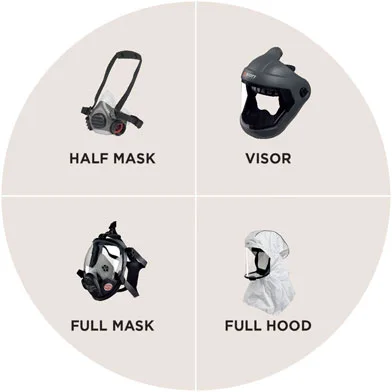
A half face mask can be used to protect
against a wide variety of harmful substances
within its protective capability, determined
by mask type and filter efficiency.
Use a full-face mask/hood if eyes and/or
head need protecting from a particular
hazard, for example in paint spraying
applications that can damage eyes.
Selection drivers are often based
on comfort rather than protection.
Certain types of respirator are
more effective and
comfortable for use over
longer periods of time. In
this case, a hood with
airline could be selected.
Where head
protection is also
required, use a headtop
incorporating a helmet.
If an unrestricted
view is required – then a
‘panoramic’ type
facemask would be
suitable.
Often ‘clean-room’
environments need to consider
the requirement for protecting
the product from the worker rather
than the worker from the product,
such as in pharmaceuticals/electronics
assembly. In this instance a headtop without
conventional exhale valve could be selected.
For welding applications, in addition to
respiratory protection against welding
fumes and gases, there is a need for a
darkening filter integral in the headtop to
protect welders’ eyes from radiation
exposure.
1http://erj.ersjournals.com/content/35/2/234.full
IPE Newsletter
IPE publishes a weekly eNewsletter, delivering a carefully chosen selection of the latest stories straight to your inbox.
Subscribe here