

Safely shifts server systems
While the process of installing and removing computer
servers within the telecommunications industry isn’t
technically difficult,problems do arise with the handling of
servers, especially when they are housed within a blad
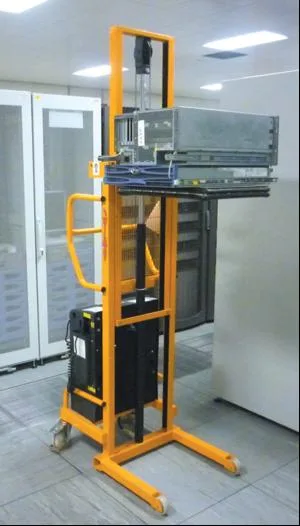
While the process of installing and removing computer
servers within the telecommunications industry isn’t
technically difficult,problems do arise with the handling of
servers, especially when they are housed within a blade
enclosure or chassis, as Wilmat explains
BT Group currently has 30 data centres
UK-wide, all of which have server
rooms. To make best use of this space,
the servers are housed together in a blade
chassis, which then slides into a cabinet.
Server rooms can hold literally hundreds of
cabinets, the connections of which take
somewhere in the region of 36km of wiring.
A blade chassis or enclosure holds multiple
blade servers which provide services such as
the management of power, cooling,
networking and various interconnectors. The
combined weight of a blade chassis is
upwards of 100kg and having the right
handling equipment is necessary to install
and remove the servers as and when required.
Steve Gauge, technical specialist at BT’s
data centre in Oswestry, Shropshire,
comments: “The HP C7000 chassis holds
eight full-height or 16 half-height blade
servers.We needed a manual handling truck
which would enable the operator to lift and
manoeuvre the equipment in a safe and
responsible way. The truck is also required to
provide a solid foundation for the precise
installation of the blade chassis. If the chassis
is not aligned to the rack mounts exactly, its
weight can damage the racks, making the
cabinet unusable.”
BT’s data centre specialists needed to find a
manual handling truck which would provide
safe operational use and be able to fulfil the
tasks required. BT turned to Wilmat, a
specialist manufacturer of bespoke switchgear
handling equipment.
Gauge continues: “Being able to do a job
first time and as efficiently as possible is very
important to us, so we need the tools to help
us achieve this. The equipment we use has to
be solid, robust and reliable to enable us to
reach stringent installation and maintenance
targets, both quickly and safely.”
Gauge and his colleagues at BT’s Oswestry
site are also responsible for providing data
centre training across the UK. Over the past
three years they have developed the BTEC
accredited Data Centre Services training
scheme. This focuses on the installation and
decommissioning of servers and the correct
maintenance of racking and server cabinets.
Recently training has been expanded to
include the handling of blade chassis.
“The course has been designed to cover all
areas of practical data centre management,
including racking, server installation and
decommissioning,” explains Gauge. “We’re
currently developing training on the blade
chassis; this includes using lifting equipment.
We received an insight on using the Wilmat
truck when we first purchased it from a
technician who came out on site and
delivered a training and familiarisation
programme on how to use the truck, safety
issues and best practice in general
maintenance.
“We’ve taken this information and
included it in the current training
programme we deliver to all our data centres
across the UK, ensuring correct procedures
are adhered to at all times.”
A key requirement was for the equipment
used by BT to come with a full maintenance
and after-sales service. However, this presents
a possible problem, as Gauge explains:
“Gaining access to one of our data centre
sites can be difficult because of the security
aspect, but Wilmat give us plenty of
notification when they need to visit to
complete the service contract. They always
comply with our procedures, which can be
stringent as one would expect, and there have
been no abortive visits from the company.”
Looking ahead, as computer capacity
becomes more powerful, the need for more
servers will be required and space is already
becoming a premium within data centres.
This demand for space is on-going and
technology is already looking at ways to
make servers more compact. The flip side to
this is in the weight of the physical device.
Lifting these compact server enclosures will
require the use of robust and reliable manual
handling trucks.
Wilmat is helping BT to stay at the
forefront of technological advances by
making the transportation and installation of
the new generation servers as they come into
operation an everyday task that can be
completed safely and swiftly, which benefits
all concerned, including BT’s customers.
Gauge concludes: “At the end of the day,
we’re here to make the connection to our
range of services as quick and easy as possible
for our customers; with the right equipment
and support, we’re achieving this and can
look forward to what the future will hold for
the telecommunications industry.”
IPE Newsletter
IPE publishes a weekly eNewsletter, delivering a carefully chosen selection of the latest stories straight to your inbox.
Subscribe here