

Sapphire lenses for industrial applications
A high-specification alternative to glass, already widely used in the aerospace and defence sectors, is now being offered for a variety of industrial applications by Morgan Advanced Materials.
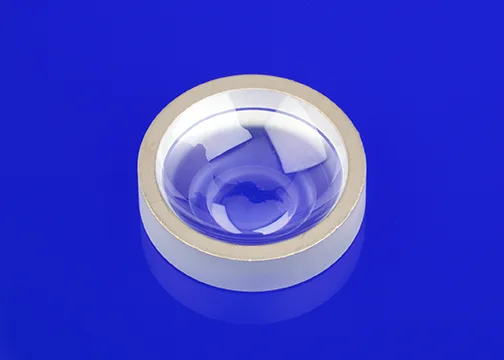
Made from a single aluminium oxide crystal, sapphire-based lenses are optically transparent from infrared through visible to UV light. The high strength sapphire lenses are reported to retain all mechanical proprieties across a wide temperature range from cryogenic (-150°C and below) to more than 2000ºC. They are said to feature the highest melting point at around 2040ºC.
Their strength and hardness mean they will not suffer surface damage or devitrification caused by extreme thermal cycling and they are resistant to most of the commonly encountered chemicals. High radiation systems also offer resistance to solarisation (UV radiation darkening). The material’s high dielectric constant and low loss tangent means it is suited to low-loss, long-wavelength windows and electrical insulators.
Sapphire lenses are supplied either pre-metallised for in-house braze assembly by customers, or as a complete unit with metal housings produced to customer specifications. The latter provides a hermetic seal suited to ultra-high vacuum (UHV) applications which can be subjected to repeated thermal cycling, and still maintain a helium leak rate equal to or less than 1x 10⁻⁹ mBar l/sec. Lenses can be supplied flat, or with single or double convex faces.
Further applications for which this technology is suitable include optical windows for infrared thermal detection; windows for semi-conductor plasma and chemical etching; and windows for furnaces, pyrometers and other high-temperature processes.
Oliver Petersen of Morgan Advanced Materials explained: “Sapphire boasts a unique range of properties and while it is widely used in the aerospace and defence sectors, we are seeing greater demand in applications where any lessening of the transparency cannot be compromised, for the sake of process quality or safety. With a range of sealing options and braze alloys available, we believe the list of potential applications could be much longer.”
IPE Newsletter
IPE publishes a weekly eNewsletter, delivering a carefully chosen selection of the latest stories straight to your inbox.
Subscribe here