

Small robots big on functionality
Benchtop robots achieve a high level of functionality, are
readily available, simple to implement and inexpensive.
Peter Swanson, managing director of Intertronics explains
Large multi-axis robots are familiar – we
Benchtop robots achieve a high level of functionality, are
readily available, simple to implement and inexpensive.
Peter Swanson, managing director of Intertronics explains
Large multi-axis robots are familiar – we
see them on television welding or
spraying cars.What may not be so
familiar is the success of smaller benchtop
robots, which since the mid-1990s have
taken on assembly tasks on more modestly
sized products, and in some SMEs are now a
significant factor in regeneration of UK
manufacturing industries.
Small robots with footprints about A4 in
size and working areas of 200 x 200mm have
all the functionality of large machines. Bigger
versions cover 800 x 600mm with a Z-axis of
200mm. They are fit for shop floor use and
maintenance is relatively simple – often with
internal computers and self-diagnostic
protocols.
Typically, programming is via a simple
teach pendant with prompted inputs, and
programs are stored internally or kept on a
computer. Software may be generic, allowing
programmer control of functionality, or
function specific (eg dispensing).
Customised software is user-friendly, with
selectable point-to-point or continuous path
motion.While 2-axis machines are available,
3-axis are the most popular, with full
interpolation of lines, arcs and circles
through all three axes. A fourth, rotational
axis is used for more complex, non-planar
jobs. Positional repeatability is typically
0.01mm and movement speeds can reach
1m/sec. Inputs and outputs allow interfacing
with external devices (eg pick and place
pneumatics). Sophisticated camera-based
position correction systems are now
available. Types include:
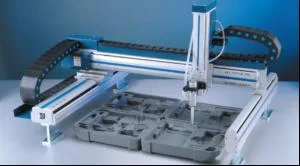
Semi-automatic, cartesian robot – the
work is placed on a moving plate on the
bed of the machine, which provides x-axis
movement. Overhead, a beam mounted
traveller gives the y- and z-axis movement.
SCARA robot – Selectively-Compliant-
Articulated-Robot-Arm, or sometimes
Selective-Compliant-Assembly-Robot-
Arm.With joints much like a human arm
(shoulder, elbow and wrist axes), it
performs pick/place, palletising or
dispensing functions.
Gantry robot – an overhead beam moves
back and forth over the work on a fixed
base. A z-axis component slides on the
gantry.
All types are suitable for semi-automatic
batch operation, where the work is manually
loaded/unloaded. The SCARA and gantry
types will also work with automatic feed by,
for example, being placed next to or over a
conveyor.
Typical applications include: Dispensing,
soldering, brazing, welding, pick and place,
screwdriving, engraving, cutting, testing and
calibration, and dispensing. Adhesives,
sealants, encapsulants, potting compounds,
coatings, inks, paints, greases, oils, solder
pastes, and so on may be accurately metered
onto workpieces – dispensed from barrels or
cartridges mounted on the machine z-axis,
or remotely located and fed through a robot
mounted dispensing valve. Beads, coatings or
micro-dots are common.Metering and
mixing equipment can be interfaced to
dispense two-part systems.
One popular application is the dispensing
of form-in-place (FIP) gaskets onto a
component, which then cures into a soft,
sealing gasket. The bead must be the same
diameter over its entire length, and so the
dispense needle travel-speed must match the
FIP gasket flow rate, even around corners in
three dimensions. A robot can be
programmed to do this, whereas a human
would find it impossible.
Test & calibration
Typically a camera is sequentially positioned
over a number of small parts. The image is
then examined by computer, to detect a pass
or fail. Reject parts may be identified,
marked or removed while on the robot.
Probes can be accurately positioned to
measure electrical or thermal characteristics:
eg thermostat calibration – using a robot,
interfaced to the testing equipment, which
adjusts the calibration screw until the
appropriate electrical output is achieved.
Benefits claimed include
Quality – robots are accurate and do not
get distracted. Product integrity is
enhanced.
Production yield – generally reject rates go
down.
Throughput – robots can work
continuously and can be faster than
humans
Necessity – sometimes the job just cannot
be accomplished by a human.
Material savings – Expensive materials are
dispensed accurately and multi-part
material mixing may require purging or
nozzle changes unless dispensed
continuously.
Benchtop robots achieve a high level of
functionality, are readily available, simple to
implement (no need to understand robot/
machine language/PLC programming and
no previous experience required). Prices start
at about £4000. At this level, cost justification
resulting from higher throughput and yields,
fewer rejects, better quality or reduced
labour content is relatively straightforward.
Payback can be as little as six months – vital
to companies who would like to see domestic
manufacturing both stay in the UK, and lead
the economic recovery.
IPE Newsletter
IPE publishes a weekly eNewsletter, delivering a carefully chosen selection of the latest stories straight to your inbox.
Subscribe here