

Spotlight falls on retrofit options
Before investing in a new lighting installation to save
energy, it makes sense to take a look at what the latest lamp
and control gear technologies can offer as a retrofit,
according to Clive Riddell of Venture Lighting
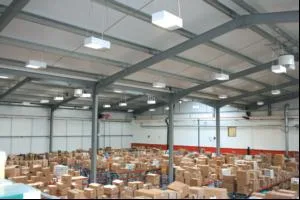
Before investing in a new lighting installation to save
energy, it makes sense to take a look at what the latest lamp
and control gear technologies can offer as a retrofit,
according to Clive Riddell of Venture Lighting
Acombination of economic pressures,
energy legislation and sustainability
commitment is leading many
companies to look for quick, cost-effective
ways to reduce energy consumption and
carbon emissions. And if they can improve
the quality of the workplace at the same
time, then so much the better.
To that end, lighting offers a ‘quick win’
opportunity that can make a
significant difference to energy
consumption at relatively low
cost and with a sensible
payback. In this respect,
taking advantage of recent
advances in lamp and control
gear technology – often
simply by replacing existing
lamps with more efficient
ones – offers a cost-effective
option.
For instance, if a
particular project requires
a 35,000 lumen package to
meet design requirements;
this can be achieved by using
an older technology 400W
metal halide lamp using cheap control gear.
Taking ballast losses into account, that’s a
potential electrical load of 445W per lamp.
Or, the same lumen package could be
achieved with a higher quality 350W lamp
with better control gear that provides just
25W ballast losses – giving a saving of 70W
per lamp without compromising on lighting
quality. In fact, newer lamps have a longer
life and will also maintain their light output
for longer, so lighting quality will be
improved through the life of the lamps.
Similarly, there are now 200W metal
halide lamps that can directly replace older
style 250W metal halide lamps to save 60
circuit watts, or 22% energy consumption
per fitting (including control gear losses).
Taking this principle a step further, even
greater savings can be achieved when high
pressure sodium or mercury vapour lamps
are replaced with metal halide. For example,
a modern 200W metal halide lamp will give
the same light output as a 400W mercury
vapour lamp, resulting in a 49.6% energy
saving.
These examples also serve to highlight a
major source of energy consumption of
which many building operators may be
unaware – namely the significant variation in
losses from different ballasts. Here, price
often plays a key role because there is a direct
correlation between the quality of the
product and the quality of the materials
used. Furthermore, this correlation has
become more marked recently due to
considerable increases in the price of copper
and steel.
The result is that lower priced ballasts can
usually only retain their low cost status by
skimping on materials. This, in turn, has a
direct impact on the efficiency of the control
gear. Thus, a ballast that costs less than a
higher quality model could add as much as
55W electrical load to each light fitting.
Consequently, opting for the cheapest ballast
is often a false economy.
Another important factor to take account
of is controllability – as the maximum
efficiency of a lighting installation will only
be achieved by ensuring that no light is
wasted. In offices using fluorescent lighting,
for example, it’s common practice to dim
lighting when there is plenty of natural
daylight, or when areas are unoccupied. In
warehouses and factories using traditional
high intensity discharge (HID) lighting such
as metal halide this has not been possible
because older style HID lamps could not be
dimmed and they take a while to come back
on once switched off.
This situation has now changed with the
introduction of advanced electronic ballasts
that allow these lamps to be dimmed so that
more sophisticated control strategies can be
put in place. For example, in a warehouse the
lighting in unused aisles can be dimmed to a
minimum light output and then be
immediately ramped up when someone
enters the aisle. Similarly, where daylight is
entering the space the lighting can be
dimmed while still ensuring the design
illuminance is maintained.
For any building operator who is looking
to improve the efficiency of their lighting,
the first thing is to take a look at how lamps
and control gear have changed since the
lighting was installed. In many cases, using
new lamps and/or gear will prove to be a
highly effective solution, with minimum
disruption to the workplace and a fast return
on investment.
IPE Newsletter
IPE publishes a weekly eNewsletter, delivering a carefully chosen selection of the latest stories straight to your inbox.
Subscribe here